SpaceX Put $15.8 Billion Into AI Last Quarter and $1.2 Billion Into Rockets
Inside Its First Earnings as a Public Company
The headline number in SpaceX's first report as a public company is a loss. The number that actually explains the company is a capital-spending line: $18.4 billion in three months, and $15.8 billion of it went into artificial-intelligence infrastructure.
For the quarter ended 30 June 2026 — its first since shares began trading on Nasdaq under the ticker SPCX on 12 June — SpaceX reported revenue of $7.81 billion, up 92% from $4.07 billion a year earlier, and a net loss of $541 million. A loss framed on its own reads like a company in trouble. Read against the prior year, it is the opposite direction of travel: the loss was $1.0 billion in the same quarter of 2025, so it narrowed by $467 million even as the business nearly doubled.
That is the gap a reader who saw only the word "loss" needs closed. This was not a company sliding backwards. It was a company growing fast and choosing to spend the proceeds — and then some — on a bet that has nothing to do with rockets.
A smaller loss, not a bigger one
The gap between "posts a loss" and what the filing shows is the whole story here. Net loss per share came in at 9 cents, against 34 cents a year earlier. The loss from operations — the figure before interest and one-off items — was just $143 million, down from $970 million. Adjusted EBITDA, a non-GAAP measure the company leans on, was $3.5 billion against $1.2 billion, though that number strips out the depreciation and share-based pay that a capital-heavy business like this one genuinely incurs, so it flatters the picture and should be read as the company's chosen lens rather than the statutory result.
None of that makes the loss imaginary. It makes it a loss that is shrinking on revenue that is surging — a very different thing from a loss that is widening because customers are leaving. The company's own commentary called the quarter proof of "the true power of SpaceX" and pointed to margin expansion "led by our new AI compute agreements." The commentary is attributed only to "CFO Commentary"; the release names no executive, and does not quote the founder.
Where the $18.4 billion went, and it was not the rockets
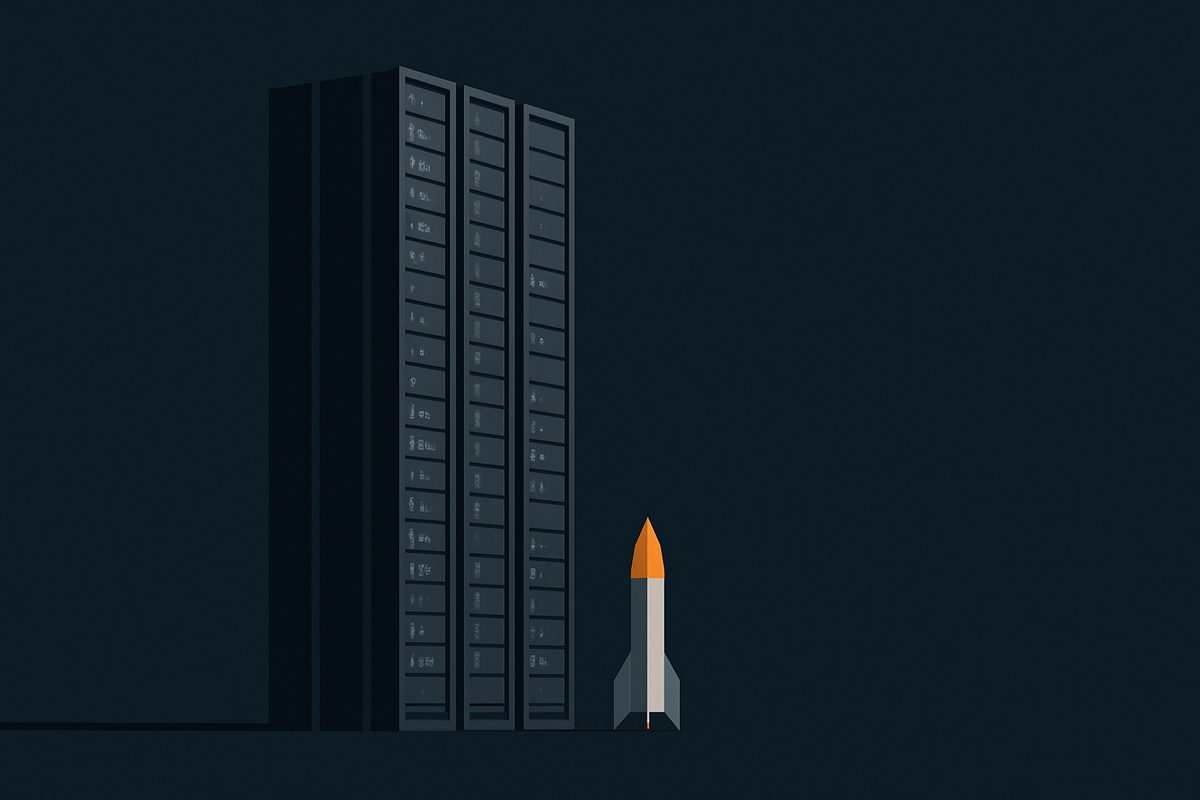
The capital-spending table is where a "space company" stops looking like one. Total capex was $18.4 billion, more than six times the $2.8 billion of a year earlier. Of that, the space segment — the rockets, the launches, Starship — took $1.2 billion. The AI segment took $15.8 billion.
That is not a rounding difference. It is roughly thirteen dollars of AI build-out for every dollar spent on the launch business that made the company's name, in a single quarter. The company describes the AI spend as the build-out of compute capacity, which it puts at 1.4 gigawatts, up from 1.0 a quarter earlier and 0.4 a year before. On top of the capital spending, it announced an agreement to buy the coding tool Cursor for $60 billion, expected to close in the third quarter, and said it had signed cloud-services contracts it valued at $14.1 billion, $1.6 billion of which it recognised as revenue in the quarter.
The AI segment is not small, and it is growing fastest of the three: revenue of $2.56 billion, up 247% year on year, from advertising and from selling AI computing to other companies. But it also lost the most money — an operating loss of $1.26 billion — and it is where almost all the capital is going. Whether that spending pays off is the same open question hanging over the whole sector — the one that produced the day the Kospi fell 10.8% and Nvidia dropped 5%, when investors flinched at the sheer scale of AI capital budgets. SpaceX has now put a very large number on the same bet.
Starlink pays for everything else
The reason the company can lose money on AI and rockets and still narrow its overall loss sits in one segment: connectivity, which is mostly Starlink. It brought in $4.29 billion of revenue, up 66% year on year, and — unlike the other two segments — it made money, with operating income of $1.66 billion, up 79%. Space lost $542 million at the operating line; AI lost $1.26 billion. Connectivity's profit is what absorbs most of both: add the three together and the group's operating loss is only $143 million.
A detail worth holding onto: Starlink's subscriber base doubled to 12.0 million, yet average revenue per user fell to $66 a month from $85 a year earlier. The profit rose because there are far more customers, not because each pays more — a pattern that works while subscriber growth stays fast and is worth watching if it slows. The segment also signed airline and mobile-carrier deals during the quarter and was awarded more than $6 billion in multi-year U.S. government contracts for Starshield, its secure network for government customers.
The rockets are a research project right now
The launch business, for all that it defines the brand, is the smallest of the three by revenue and is running at a loss on purpose. Space revenue was $962 million, up 29% year on year, and the segment lost $542 million from operations because research-and-development spending on the next-generation Starship rose sharply — the company frames it as an investment it believes will cut the cost of reaching orbit by "99% or more."
The operational record behind that is real: 78 launches and 1,041 metric tons to orbit over the first half of the year, most of it deploying Starlink's own satellites. Starship completed a suborbital test in May and, after the quarter closed, a further flight in July that the company says deployed 20 production satellites and executed its softest splashdown yet. These are development milestones, not revenue — which is precisely why the segment loses money while the company keeps funding it.
The half-year figure that looks alarming, and why it differs
Anyone comparing reports will find a much larger loss elsewhere: for the six months to 30 June, the net loss was $4.82 billion, not $541 million. Most of that gap is not operating performance. The half-year operating loss was $2.09 billion, and a single non-operating line — "other income (expense), net" of $1.96 billion — accounts for much of the rest. The release does not itemise what that line contains, so the honest statement is that the six-month loss is real but is not six months of the trading pattern the quarterly numbers show, and the filing does not explain the difference in the release itself.
Cash is not the worry either way. The company ended the quarter with about $100 billion in cash, equivalents and marketable securities, having raised roughly $85.7 billion of net proceeds in the June listing — 638,888,888 shares priced at $135.00 — and closed a $25 billion debut bond in the same month, part of which repaid an existing bridge loan. Its stated backlog was $47.5 billion, and its operating activities generated $3.47 billion of cash over the half, even as investing outflows of $34.5 billion show where that cash and the new capital are going.
The question the numbers leave open
SpaceX is now, on its own figures, three businesses: a profitable satellite network, a launch operation spending heavily on a next-generation rocket, and an AI arm consuming capital at a rate that dwarfs both. The company's own commentary frames the spending as deliberate — the financial strength, it said, gives it "substantial capacity to invest in Starship, Starlink Broadband and Mobile satellites, and our AI platform, while maintaining a disciplined long-term capital allocation framework."
What the first report does not settle is whether the market will keep valuing that combination as one company. Investors have lately rewarded restraint on exactly this kind of spending — the logic behind Apple's brief touch of a $5 trillion valuation was that it was staying out of the AI-infrastructure arms race. SpaceX has walked straight into it, funded for now by the dishes on people's roofs. The next few quarters will show whether the AI segment starts to earn its capital or simply keeps needing more of it — and whether a satellite business, however profitable, can keep carrying two loss-making ventures at once.
Sources and verification
All financial figures are from SpaceX filings with the U.S. Securities and Exchange Commission (Space Exploration Technologies Corp., EDGAR CIK 1181412), each opened and read. Figures are for the three months ended 30 June 2026 unless stated as six-month or prior-year figures. Adjusted EBITDA and segment Adjusted EBITDA are non-GAAP measures defined by the company. Analyst estimates, any full-year projection, and the share-price reaction are not included because they could not be confirmed from the primary filings. Management commentary is attributed in the release to "CFO Commentary" with no named individual, and no other executive is quoted.
- SpaceX Q2 2026 earnings release (Exhibit 99.1 to Form 8-K, 4 Aug 2026): https://www.sec.gov/Archives/edgar/data/1181412/000162828026052515/earningsreleaseq22608042.htm
- SpaceX Form 8-K reporting second-quarter 2026 results (4 Aug 2026): https://www.sec.gov/Archives/edgar/data/1181412/000162828026052515/spcx-20260804.htm
- SpaceX Form 10-Q for the quarter ended 30 June 2026 (4 Aug 2026): https://www.sec.gov/Archives/edgar/data/1181412/000162828026052535/spcx-20260630.htm
- SpaceX Form 424B4 final IPO prospectus (12 June 2026): https://www.sec.gov/Archives/edgar/data/1181412/000162828026042639/spaceexplorationtechnologi.htm
- SpaceX Form 8-K on IPO pricing (23 June 2026): https://www.sec.gov/Archives/edgar/data/1181412/000162828026044955/spcx-pricing8xk.htm
- SpaceX Form 8-K on IPO closing (26 June 2026): https://www.sec.gov/Archives/edgar/data/1181412/000162828026045763/spcx-closing8xkjune2026.htm
- SpaceX Form 8-K on its inaugural bond issuance (22 June 2026): https://www.sec.gov/Archives/edgar/data/1181412/000162828026044489/exhibit991-8xk.htm
- SEC EDGAR filing index, Space Exploration Technologies Corp. (CIK 1181412): https://www.sec.gov/cgi-bin/browse-edgar?action=getcompany&CIK=1181412&type=&dateb=&owner=include&count=40