Apple Just Touched $5 Trillion - and It Got There by Doing Less AI, Not More
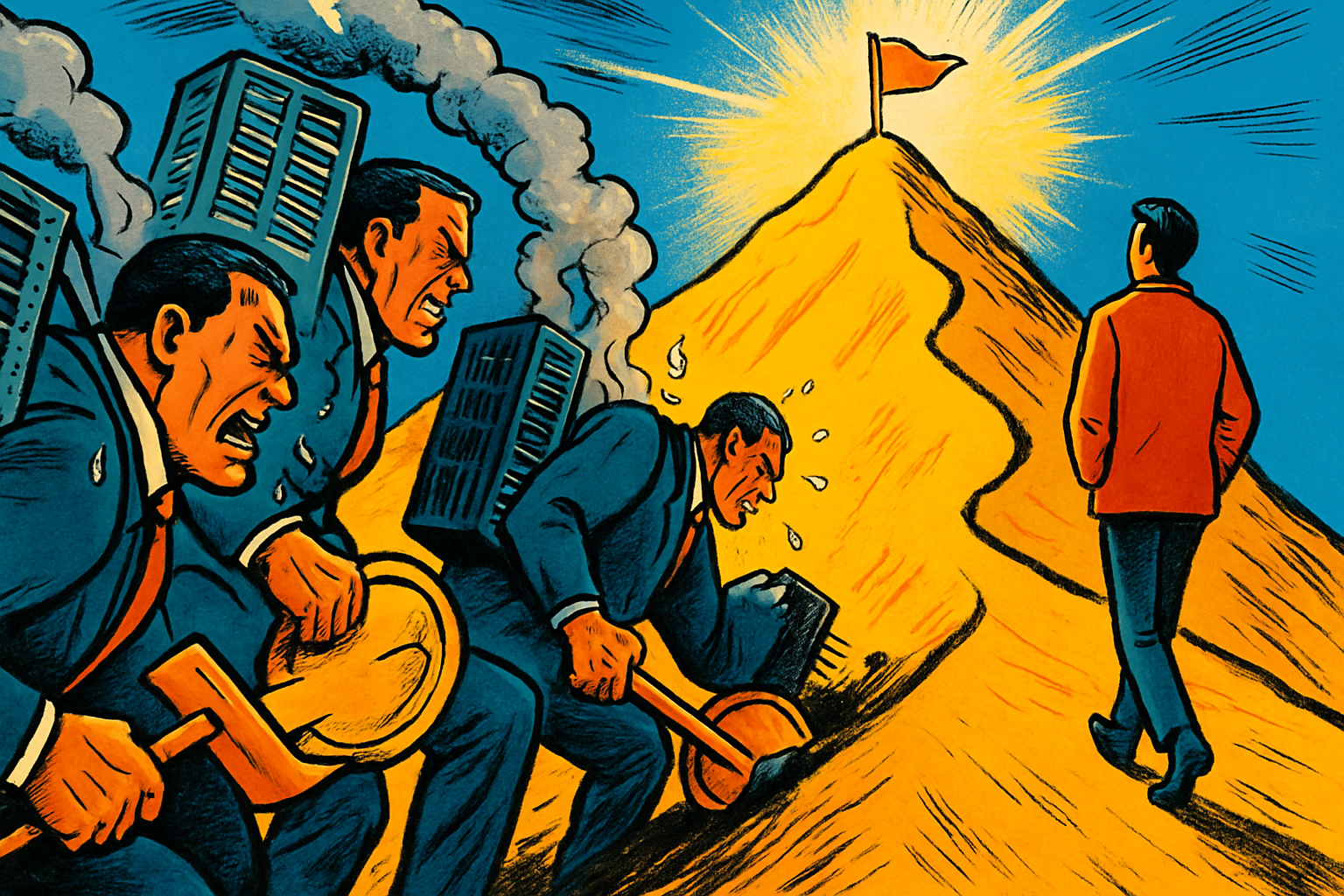
For one stretch of trading on Tuesday, Apple became something only one company in history had ever been: worth five trillion dollars. Then, before the closing bell, it stopped being that again.
That is the whole story in a sentence, and it is worth slowing down on, because the headline you probably saw - "Apple hits $5 trillion" - is true but incomplete in a way that matters. The milestone was real, it was rare, and it was brief. And the reason Apple got within touching distance of it is almost the opposite of what you might assume in a year when every tech headline is about spending fortunes on artificial intelligence. Apple got here, in large part, by refusing to.
So here is the calm version: what actually happened to the share price, who else has ever stood at this line, why investors are rewarding the one big tech company that is not pouring money into AI data centres, and which parts of the excitement the reporting does not quite support.
The number, and the asterisk on it
On Tuesday 28 July 2026, Apple shares climbed as high as $342.89. At that price the company was worth about $5.036 trillion - just over the five-trillion line, and enough to make Apple the second listed company ever to touch it.
But an intraday high is not the same as a milestone that sticks. To be able to say Apple "officially" crossed $5 trillion, the stock needed to close the day above roughly $340.43. It did not. The gains faded through the session - Forbes described the stock paring back to be largely unchanged - and by later trading Apple was back around $339.70, which put its value at about $4.991 trillion, a hair under the mark. So the accurate way to say it is the way the more careful outlets did: Apple briefly touched $5 trillion, and did not close above it.
That is not a technicality invented to spoil the party. It is the difference between "a company is now worth five trillion dollars" and "a company was worth five trillion dollars for part of one morning." Both are remarkable. Only one of them is what happened.
Second in line, and a long way behind the first
Apple is the second company ever to reach this level, which naturally raises the question: who was first?
Nvidia. The chip designer at the centre of the entire AI boom became the first publicly listed company ever valued at $5 trillion back in late October 2025 - on 29 October, when its shares jumped more than 5% in a single session. CBS News put the move at about 4.5%, to $210.11; TechCrunch had it rising as much as 5.6%, to $212.19. Either way, Nvidia cleared a line no company had ever reached, and it had done so at breakneck speed, having only passed $4 trillion that July.
The contrast with Apple's route is the interesting part. Nvidia sprinted to $5 trillion on the back of the AI-chip frenzy - CEO Jensen Huang told the market the company had visibility into "half a trillion dollars" of revenue, with more than $500 billion in orders booked through the end of 2026. Apple ambled there over nine months, having first crossed $4 trillion in October 2025, and it did so while being the big tech name investors kept criticising for being slow on AI. Same finish line, opposite reasons for standing on it.
The paradox: Apple got here by sitting out the AI race
Here is the twist that makes this more than a round-number story.
The dominant worry hanging over the market in 2026 is not whether AI is real. It is whether the staggering sums being spent on it - the data centres, the chips, the power contracts - will ever earn a return that justifies the outlay. That anxiety has been punishing the companies doing the heaviest spending. And Apple, almost alone among the giants, has not been doing it.
Dipanjan Chatterjee, vice president and principal analyst at Forrester, summed up the logic in comments carried across the coverage of the milestone: "Apple has resisted the AI spending race, betting that customer experience - not infrastructure investment - will ultimately determine the winners." That is the bet investors were rewarding on Tuesday. While rivals answer hard questions about billions sunk into infrastructure, Apple looks like the company that never made that wager.
It is important not to overstate this into the idea that Apple has stepped away from AI entirely, because that is not true. Apple's approach is to lean on other people's infrastructure rather than build its own: it has turned to Google's technology to help power a revamped Siri, effectively renting the heavy machinery instead of buying it. The strategy is not an absence of AI. It is a decision about who pays to build the expensive part - and, so far in 2026, the market has decided that not being the one holding that bill is a virtue.
The underlying business helps too. Apple stock is up roughly 24% so far this year, and close to 60% over the past twelve months, a climb the reporting ties to strong demand for iPhones rather than to any AI narrative. Coverage of the milestone also pointed ahead to a fall product lineup said to include a foldable iPhone and an iPhone 18 - though those are reported plans for later in the year, not products on shelves today, and are worth holding as exactly that.
What "investors flee AI stocks" actually means here
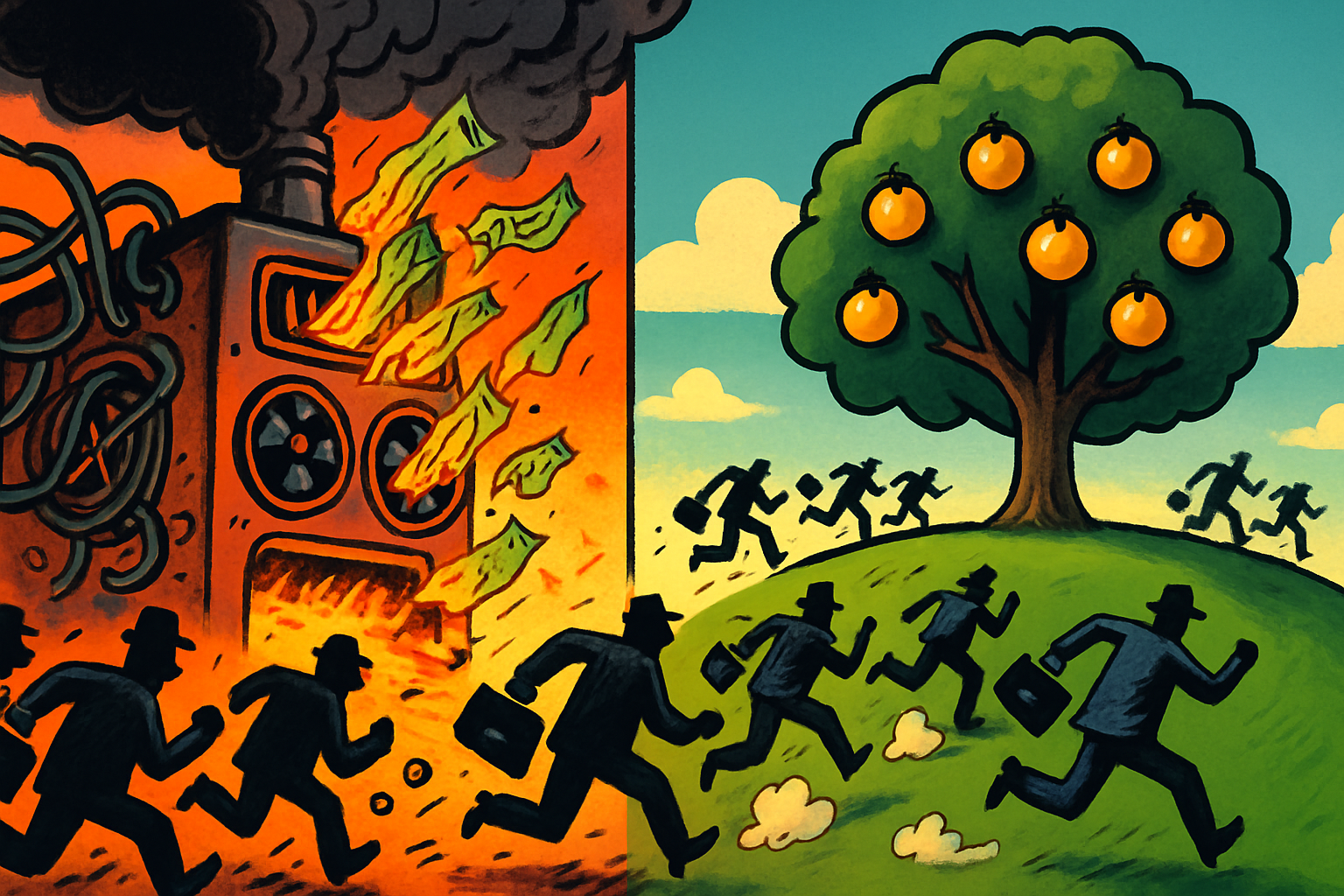
The framing you will see attached to this story is that Apple hit $5 trillion "as investors flee AI stocks." That is a fair shorthand, but it is worth unpacking, because "flee" sounds more dramatic than the figures I could verify.
What has genuinely happened is a rotation - money moving out of the heaviest AI spenders and into names seen as safer. Even on the day Apple was climbing, Nvidia was slipping: Forbes noted Nvidia was down about 1.4% on Tuesday, and pointed out that for all its status as the AI bellwether, its stock was up just 2.6% for the year - a striking lag behind Apple's 24%. Microsoft, another company spending heavily on AI infrastructure, was reported by Yahoo Finance to be down roughly 28% from its own October 2025 high.
So the picture is not that AI collapsed. It is that the market has started to separate the companies spending on AI from the companies it thinks will benefit from it, and to prefer the latter. Apple, which sells the devices AI features run on without carrying the cost of the data centres behind them, sits neatly on the popular side of that line right now. That is the rotation those "flee AI" headlines are gesturing at - not a crash, but a change of favourites.
I should be straight about the limits here: I did not find a verified total for how much value has come off AI stocks in this stretch, and I am not going to invent one. The Nvidia and Microsoft figures above are the concrete numbers the reporting gave, each from a single outlet, and I am attributing them as such rather than dressing them up as a market-wide tally.
A quick reality check on the crown
One more thread, because it keeps getting tangled. Apple did not only rise on Tuesday - it had already, days earlier, reclaimed the title of the world's most valuable listed company, overtaking Nvidia around Monday 27 July after a first brief overtake in mid-July. So the $5 trillion near-miss did not come out of nowhere; it was the top of a climb that had already put Apple back in first place.
That is a genuine changing of the guard at the very top of the market - the AI-chip champion and the iPhone maker trading the number-one spot back and forth - and it is a neat illustration of how fast sentiment is moving. The company that raced to $5 trillion on AI optimism in October, and the company that strolled toward it on AI restraint in July, are the same two names swapping places at the summit.
What we cannot say yet
A few honest gaps, because they are part of the story rather than an omission.
We cannot say Apple is "a $5 trillion company" in any settled sense off the back of Tuesday. It touched the level and slipped back below it before the close. Whether it goes on to close above $5 trillion in the days after this was written is exactly the sort of thing I will not guess at.
We cannot lean on a single tidy figure for the AI selloff. The individual stock moves are documented; a grand total is not, at least not in anything I opened and read.
And we should not read Apple's caution as either genius or complacency confirmed. Sitting out the AI-infrastructure race looks smart on a day when that spending is under suspicion. On a different day - if those data-centre bets start paying off visibly - the same restraint could look like being late. Tuesday was a vote for one of those futures. It was not the final count.
The bottom line
Strip away the round number and here is what Tuesday actually told us. A second company, for the first time, briefly stood where only Nvidia had stood before. It got there not by out-spending the AI boom but by staying out of its most expensive part, and letting a strong iPhone business and a lighter-touch AI strategy do the work. The market, for now, likes that trade. The five-trillion mark itself came and went inside a single session - which is a fitting summary of a moment that was historic, real, and not yet settled, all at once.
Sources
- Yahoo Finance - "Apple briefly hits $5 trillion market cap, second ever after Nvidia": https://finance.yahoo.com/markets/stocks/articles/apple-briefly-hits-5-trillion-164828856.html
- Yahoo Finance - "Apple tops $5 trillion market cap, only second company to hit the milestone": https://finance.yahoo.com/technology/article/apple-tops-5-trillion-market-cap-only-second-company-to-hit-the-milestone-134013795.html
- Forbes - "Apple Briefly Surpasses $5 Trillion Market Value - Joining Nvidia": https://www.forbes.com/sites/tylerroush/2026/07/28/apple-briefly-surpasses-5-trillion-market-value-joining-nvidia/
- Investing.com - "Apple becomes second ever company to pass $5 trillion market cap": https://www.investing.com/news/stock-market-news/apple-becomes-second-ever-company-to-pass-5-trillion-market-cap-93CH-4817140
- MacDailyNews - "Apple briefly hits $5 trillion market cap, becoming only the second company to reach the milestone": https://macdailynews.com/2026/07/28/apple-briefly-hits-5-trillion-market-cap-becoming-only-the-second-company-to-reach-the-milestone/
- TechCrunch - "Nvidia becomes first public company worth $5 trillion": https://techcrunch.com/2025/10/29/nvidia-becomes-first-public-company-worth-5-trillion/
- Yahoo Finance - "Nvidia becomes first company to close above $5 trillion market cap": https://finance.yahoo.com/news/nvidia-becomes-first-company-to-close-above-5-trillion-market-cap-133101442.html
- CBS News - "Nvidia becomes the world's first $5 trillion company, buoyed by AI boom": https://www.cbsnews.com/news/nvidia-5-trillion-nvda-stock-market-cap-valuation-ai-chips/
- Fortune - "Nvidia is officially the world's first $5 trillion company": https://fortune.com/2025/10/29/nvidia-first-5-trillion-company-ceo-jensen-huang-500-billion-revenue-blackwell-rubin-gpus-china/