Chip Stocks Just Had a Very Bad Day - Here Is What the AI Sell-Off Actually Means, and What It Doesn't
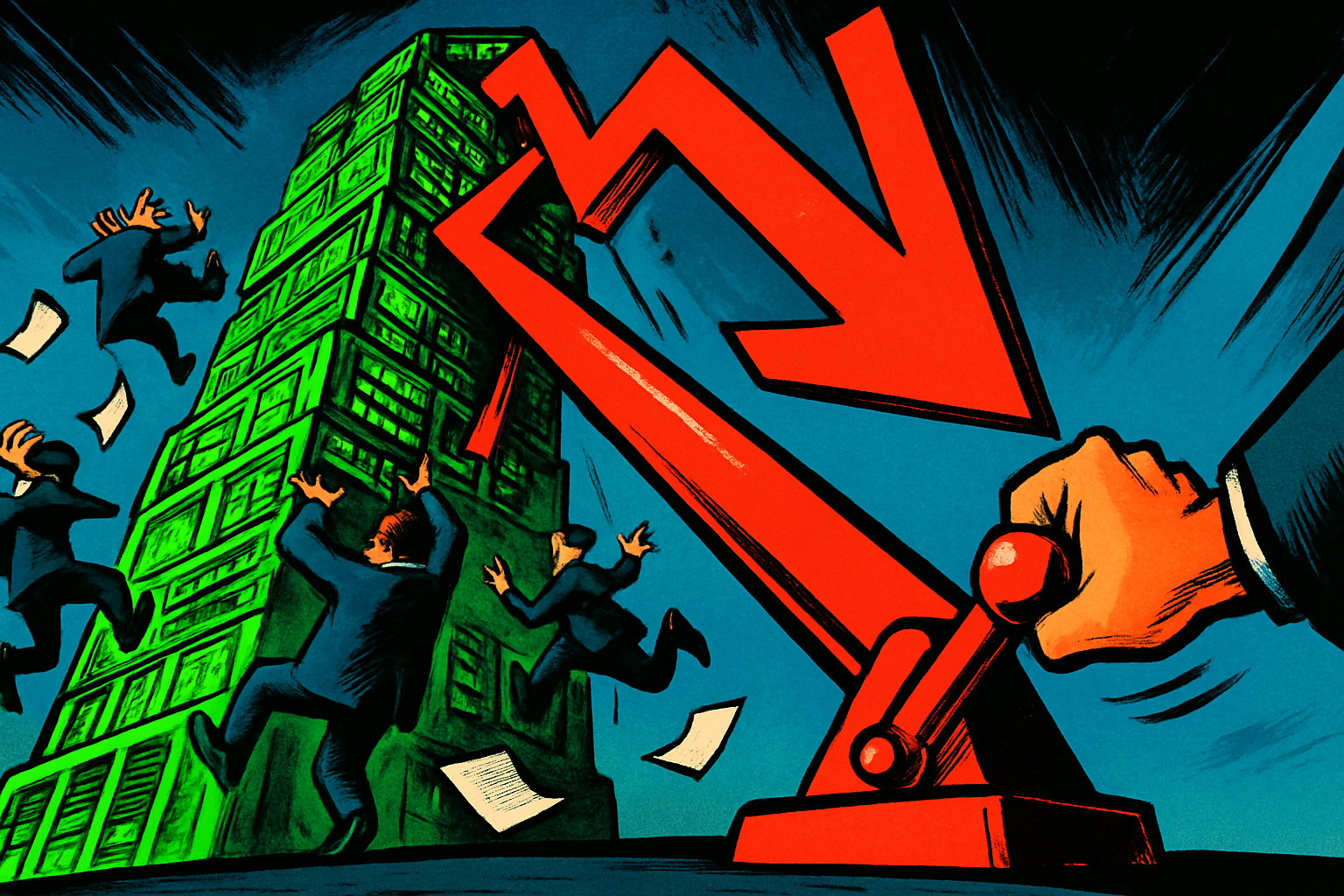
If you glanced at the markets on Tuesday and saw a wall of red next to the words "chips" and "AI", you were not imagining it. On Tuesday 28 July 2026 a sell-off in artificial-intelligence and semiconductor shares that had started overnight in New York rolled straight into Asia, and it hit hard enough that South Korea had to hit the pause button on its entire stock market.
Days like this generate a lot of loud headlines, and loud headlines are where small distortions creep in. Some framed it as a crash, some as the AI bubble finally bursting, some as Nvidia falling from grace. So here is the calm version: what actually moved, by how much, why traders think it happened, and - just as important - which of the scarier interpretations the reporting does not support. Because the difference between "shares fell sharply for a day" and "the AI story is over" is enormous, and only one of those two things is what the sources actually say.
The one-day scoreboard
Start with the numbers, because they are the part that is solid.
According to the BBC's reporting, trading on South Korea's benchmark Kospi index was paused temporarily on Tuesday morning after it slid by 8%. When the 20-minute halt lifted, it did not steady - it fell further, closing 10.8% lower. Reuters, carried by the Globe and Mail, put the exact close at a 10.84% drop to 6,023.66, its worst session in about five months, and Korea JoongAng Daily reported that this was the Kospi's eighth automatic trading halt this year and the fourteenth in its history.
That pause is worth understanding, because it is not a sign of chaos so much as a sign of a system working as designed. The halt is triggered by a mechanism called a circuit breaker, which stops trading for a set period when an index falls far enough, fast enough. The whole point is to give panicking investors a cooling-off window rather than let a slide feed on itself. The fact that Korea has now tripped it eight times in a single year tells you how jumpy this particular market has been.
The slump was led by the big technology names. The BBC reported that Samsung Electronics and SK Hynix both fell by more than 13%; Reuters had the closing figures a little steeper still, around 14%. Japan's Nikkei 225, which is also dominated by tech firms, closed almost 4% lower - TradingKey pinned it at 3.95%. So this was not a one-country wobble. It was a regional move, concentrated in exactly the companies that make the memory chips the AI boom runs on.
The spark came from a $250bn report
None of this happened in a vacuum. The trigger, according to the investment director quoted by the BBC, was Nvidia.
On Monday, in New York, shares in the AI chip giant fell by about 5%. That was enough to knock it off the top of the pile: Nvidia lost its position as the world's most valuable listed company to Apple. Yahoo Finance reported that the swap took Nvidia's market value down to around $4.77 trillion while Apple's rose to nearly $5 trillion.
What set Nvidia's shares sliding was a piece of reporting rather than a piece of hard news, and that distinction matters. The BBC, citing the Wall Street Journal, said Nvidia fell after the Journal reported that it is in talks to provide around $250bn for OpenAI as part of a massive data-centre project. The BBC added that it had contacted Nvidia and OpenAI for comment. In other words: this is a reported negotiation, not a signed, sealed and announced deal, and anyone telling you the money is already committed is getting ahead of what is actually known.
Why would news of Nvidia backing a giant customer spook Nvidia's own investors? Because it revives a worry that has been nagging at the market for months, sometimes called "circular" dealmaking - the concern that a chipmaker helping to finance the very companies that then buy its chips can start to look like a business propping up its own demand. Jane Sydenham, investment director at the investment manager Rathbones, told the BBC that AI spending is "something that's been testing investors' nerves on and off in the last couple of months." Her summary of the underlying anxiety was blunt: "Is it going to earn a proper return in the future? That's what investors are worried about."
That is the real fear under the red numbers. Not that AI is fake, but that the eye-watering sums being spent on data centres might not pay off on the timeline investors have priced in.
Why Korea fell hardest
If the spark was in New York, the biggest flames were in Seoul, and there are specific reasons the Korean market was the one to trip its circuit breaker.
Sydenham explained to the BBC that the Asian slump followed what she called "phenomenal rises" over the previous few months. The Korean market in particular, she said, is "very concentrated", with a great deal of its value tied up in just two names, Samsung and SK Hynix - both of which fell sharply on the day. When an index leans that heavily on two stocks, a bad day for those two is a bad day for everyone.
There was a second amplifier. A lot of Korean retail investors, Sydenham noted, buy shares with borrowed money, and leverage "exaggerates the movements when we get a correction like this." Borrowed money magnifies gains on the way up and losses on the way down, so a market full of leveraged buyers tends to fall faster once selling starts. The BBC's own context backs this up: the Kospi had more than doubled from the start of the year to mid-June, then gave back around a third of that value - a huge round trip that tells you just how much hot money had piled in and then rushed for the exit.
One more Korea-specific detail from the BBC: US-listed shares in SK Hynix fell 7.5% on Monday, dropping well below the $149 offer price it had when it made a record-breaking debut on the Nasdaq on 9 July. A stock trading below its own recent listing price is a vivid sign of how quickly the mood has turned.
The Apple twist

There is a genuinely interesting wrinkle in all this, and it is the reason Apple keeps appearing in a story that is otherwise about chips.
Apple did not just passively inherit the "most valuable company" title because Nvidia dropped. It has been climbing on its own, up by about 25% this year according to the BBC. And the reason investors give for liking it right now is almost the mirror image of the whole AI-spending worry.
Cheng Chye Hsern, head of investments at the wealth manager Providend, told the BBC that Apple is one of the few big tech firms "not taking part in the AI race." That, he said, is exactly what makes it appealing to investors who are nervous about the billions its rivals are pouring into data centres. Put simply: while the market frets about whether Nvidia, OpenAI and their peers will ever earn back their enormous capital spending, Apple looks like the company that is not making that bet - and on a day when that bet looked shaky, being on the sidelines was suddenly the popular place to stand.
It is a neat illustration of how the same fear moves money in two directions at once: out of the heavy AI spenders, and into the one giant that is sitting the round out.
China is in the middle of this too
A third thread runs through the day, and it points at China. Part of what unsettled chip investors was fresh evidence of how serious the competition from Chinese memory-makers is becoming.
On Monday, the BBC reported, shares in China's biggest memory chip maker, ChangXin Memory Technologies (CXMT), soared by nearly 470% as they made their debut on the Shanghai market. CXMT makes dynamic random-access memory, or DRAM - the same category of chip that powers AI data centres, phones, PCs and tablets, and a core business for Samsung and SK Hynix. The company said it plans to use most of the money raised in the listing to boost production and do more research and development.
You can see why that combination rattled the Korean giants. A well-funded new Chinese rival, expanding capacity in exactly the chips Samsung and SK Hynix sell, arriving on the same days their own share prices were already under pressure. Jun Bei Liu, the founder of the investment firm Ten Cap, told the BBC that worries about increasing competition from China were part of the picture - though she also offered a calmer read, saying investors were "taking some profit off the table" and were likely to reinvest in these stocks after the US holiday season. That last part is her expectation, not a fact on the ground, and it is worth holding it as exactly that.
Why Europe barely blinked
Here is the detail that keeps the whole thing in proportion. While Asia was tripping circuit breakers, Europe shrugged.
The big European markets, the BBC reported, all opened higher despite the AI-spending jitters. The UK's FTSE 100, France's Cac 40 and Germany's Dax 40 were each around 0.6% up a couple of hours into trading. The reason is simple: those indices have relatively little exposure to AI and chip stocks compared with Korea's tech-heavy Kospi. When your market is not built on semiconductors, a bad day for semiconductors is somebody else's problem.
That contrast is the single most useful thing to take away. This was not a broad, everything-everywhere sell-off. It was a sharp, concentrated move in one corner of the market - AI and chips - that hammered the places most exposed to it and left the places that are not almost untouched.
What this does, and does not, tell us
So what should you actually conclude from a day like this? Less than the loudest headlines want you to.
What is solid: on 27 and 28 July 2026, AI and chip shares fell sharply; Korea's market fell hard enough to halt trading and closed around 10.8% down; Nvidia dropped about 5% and briefly ceded the "most valuable company" crown to Apple; and the trigger was a mix of a reported Nvidia-OpenAI financing story, nerves about whether AI spending will pay off, and rising Chinese competition.
What is not established, and where I would push back on the scary framing: this is not a confirmed Nvidia-OpenAI deal, only a reported negotiation. Nvidia did not crash or collapse - it fell 5% and stayed the second most valuable company on earth. No source I read declared the AI bubble "burst"; the language throughout is jitters, nerves and a correction after a huge run-up, which is a very different claim. And nobody I read reported a recovery either, so I am not going to tell you the dip is already over - Jun Bei Liu's guess that investors pile back in after the holidays is a forecast, not a result.
The honest summary is the least dramatic one. A crowded, leveraged, chip-heavy set of markets had a very bad day when a fresh worry landed on top of a long stretch of spectacular gains. Whether that is the start of something larger or just a violent breather in an ongoing boom is precisely the question the day itself cannot answer - and I would treat anyone who claims to know for certain, in either direction, with the same caution the circuit breaker is built on.
Sources
- https://www.bbc.co.uk/news/articles/cly8zng43npo
- https://finance.yahoo.com/markets/stocks/articles/chip-firms-fall-us-asia-035244416.html
- https://finance.yahoo.com/markets/stocks/articles/apple-dethrones-nvidia-worlds-most-170222216.html
- https://www.theglobeandmail.com/investing/article-south-koreas-kospi-tumbles-11-as-chipmakers-slump/
- https://www.koreajoongangdaily.com/business/chipled-selloff-sends-kospi-below-6300-triggers-circuit-breaker/12795090
- https://www.tradingkey.com/analysis/stocks/more/262058149-kospi-plunges-11-kioxia-samsung-skhynix-tradingkey
- https://www.aol.com/articles/apple-dethrones-nvidia-worlds-most-170222000.html
- https://www.cnbc.com/2026/07/17/apple-nvidia-aapl-nvda-market-cap.html