The KOSPI Rose 17.91% in a Single Day
Its Biggest Gain in History, and It Still Left July Down About a Fifth
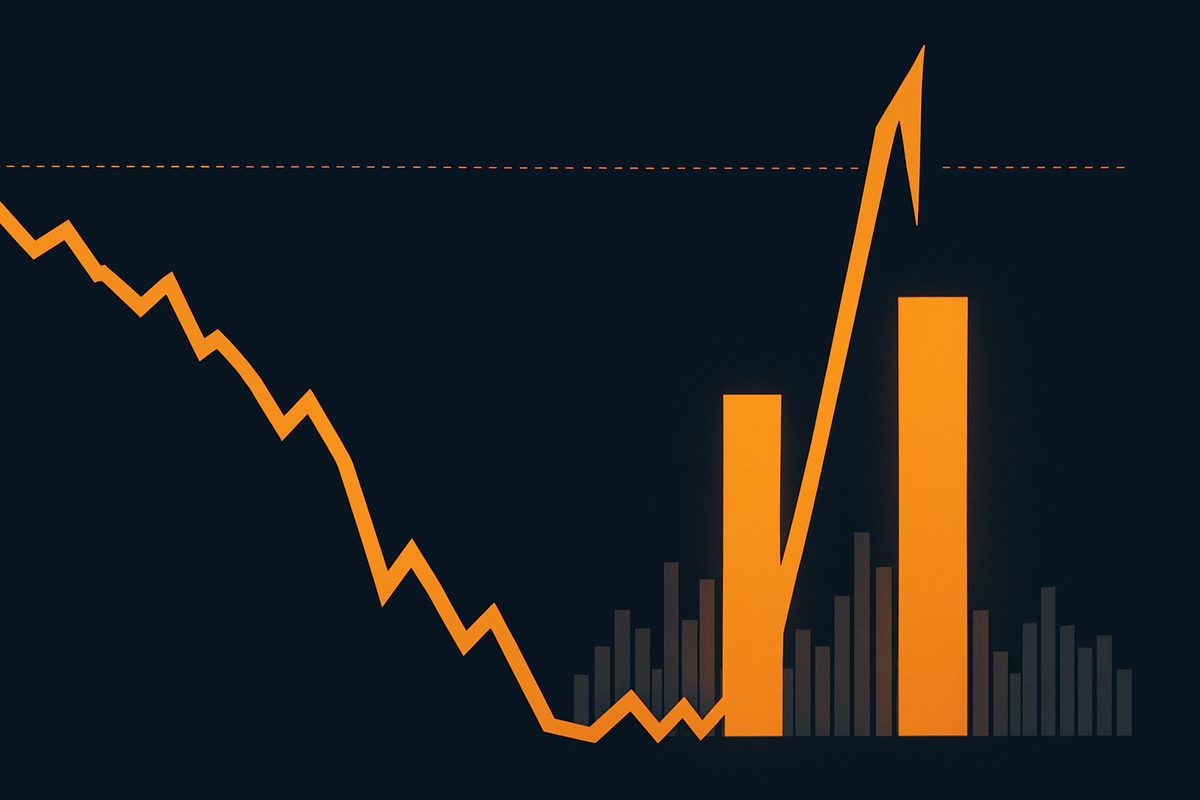
17.91%. That is how much South Korea's benchmark KOSPI index climbed on Friday 31 July 2026, closing at 6,595.45 — a jump of 1,001.89 points and the largest one-day percentage gain in the index's entire history. Then the asterisk, which most of the headlines carrying the word "record" left off: even after the biggest single day it has ever had, the KOSPI still finished July down about 22%. The record was not a market reaching a new high. It was a market clawing back part of what it had just lost.
Read the two numbers together, because separately each one lies a little. On its own, "biggest gain in history" sounds like a boom. On its own, "down 22% for the month" sounds like a rout. Both are true, on the same index, in the same week, and the only honest description of Friday is the one that holds them at once: a violent rebound inside a bad month, not the start of a recovery anyone has confirmed.
What "record" actually measures here
The record Friday broke was for a single day's gain, not for the index's level. The KOSPI did not close at an all-time high; it closed well below where it began July. What was historic was the size of the one-day move — a 17.91% jump that surpassed the previous record of 11.95%, set on 30 October 2008, during the global financial crisis. Before Friday, that October 2008 session was the only time in the KOSPI's history the index had ever risen more than 10% in a single day. The Associated Press called it simply "its best day in history."
That comparison is worth sitting with, because October 2008 is not a cheerful precedent. Records for the largest single-day gains tend to be set in the middle of crashes, not calm rallies — a market that can fall far enough, fast enough, to need a 17% day to recover is a market that has just been badly frightened. Big up-days and big down-days cluster together. The same volatility that produced Friday's record is the volatility that made the record necessary.
Why two companies moved an entire country's market
The rise was not spread evenly across hundreds of firms. It was concentrated in the two names that dominate the KOSPI: Samsung Electronics, which rose 26.81% to 262,500 won — its largest single-day percentage gain on record — and SK Hynix, which rose 29.95% to 1,718,000 won, hitting the ceiling.
That ceiling is a specific rule, not a figure of speech. The Korea Exchange caps how far any single stock can move in one session at 30% up or down. When SK Hynix rose 29.95%, it had hit the daily upper limit — reportedly for the first time — meaning it climbed as far as the exchange will allow a stock to rise in a day and was mechanically stopped there. It was not alone: several other names, including Doosan and SK Square, also finished pinned to the 30% ceiling. A stock stopped at its limit is not a stock that has found a calm new price; it is a stock with more buyers than the day's rules could accommodate.
The move was foreign money coming back. According to figures from the Korea Exchange carried by Korean outlets, foreign and institutional investors together bought a net 7.22 trillion won — roughly $5 billion — of shares on the day, with foreigners accounting for most of it. That reversed a brutal stretch: foreign investors had sold a net 18.5 trillion won across July before turning buyers in the last two sessions. A one-day change of direction that large is itself a warning as much as a reassurance — it is the signature of a market whipsawing, not settling.
Both companies make the memory chips the artificial-intelligence build-out runs on — SK Hynix in particular is a leading supplier of the high-bandwidth memory that sits next to AI accelerators. Because they are so large a share of the index, when they move nearly as one, the whole KOSPI moves with them. Friday was, in large part, two chipmakers having their best day on record and dragging the national benchmark up behind them. It also explains why the number was so extreme in both directions this week: an index this concentrated does not do small.
The three days that made a 17% day possible
None of this makes sense without the fall it reversed. The week before Friday was one of the worst the KOSPI has had.
On Tuesday 28 July the index closed 10.84% lower, at 6,023.66 — a single-day drop steep enough to trip the market's circuit breaker, the mechanism that pauses trading when prices fall too far too fast. We covered that day as it happened: the Kospi's 10.8% close and Nvidia's 5% fall were a bad day, not a verdict on the AI story. The selling did not stop there. Korea Economic Daily reports that another circuit breaker was triggered on Wednesday 29 July, and the index kept sliding into the end of the week, bottoming near 5,594 before Friday's bounce carried it back to 6,595.
So the arithmetic of the rebound is less triumphant than it looks. A market that falls from roughly 6,700 to roughly 5,594 and then rises 17.91% does not end up ahead — it ends up back around 6,595, still beneath where it started the stretch, and well beneath where it started the month. Friday undid part of the week. It did not undo the month.
The trigger for the turn came from outside Korea. The rebound tracked a bounce on Wall Street after strong cloud earnings from big US technology companies — Microsoft and Amazon among them — reassured investors that the enormous sums being spent on artificial intelligence were starting to convert into revenue. That is the exact fear that had driven the sell-off: the worry that AI data-centre spending might not pay off. When it loosened in New York, it loosened in Seoul the next morning, and the chipmakers that had been sold hardest were bought back hardest. It is the same nervous market mood that this summer briefly carried Apple to $5 trillion for spending less on the AI race, not more: the same question — does the AI money come back? — read one way on Tuesday and the opposite way on Friday.
What the record does, and does not, tell you
Here is what Friday establishes: on 31 July 2026 the KOSPI had the largest single-day gain in its history, led by Samsung and SK Hynix, in a rebound that followed a bounce in US tech. Those facts are solid and agree across the sources.
Here is what it does not establish, and where the caution belongs. A one-day rebound is not a bottom, and none of the reporting claims it is. The index still lost about 22% over July — one of its worst months on record — which means Friday's investors bought back a fraction of a much larger fall, not a market that had already recovered. A single session, however historic, does not tell you whether the AI-spending worry that drove the crash has been answered or merely paused. Markets that swing 10% down and 18% up inside four trading days are markets in which the next large move is genuinely unknown, and anyone selling you certainty about the direction is selling you the one thing the week did not produce.
What can be said plainly is narrower and more useful than a forecast: the "record" in Friday's headlines was a record for a rebound, the rebound recovered part of a sharp sell-off rather than setting a new high, and it rode on two chip stocks and a change of mood imported from New York overnight. That is the whole of what the numbers support — and on a week this loud, knowing exactly what a record does and does not mean is most of the story.
Sources and verification
Every figure here was taken from a full-text report opened and read for this piece. The close of 6,595.45, the +17.91% gain (+1,001.89 points), the description of it as the largest one-day gain in KOSPI history — surpassing the 11.95% record of 30 October 2008 — and the individual moves (Samsung Electronics +26.81% to 262,500 won, SK Hynix +29.95% to 1,718,000 won at its daily price limit) are stated consistently across the Korean and wire sources below. The net foreign-and-institutional buying of about 7.22 trillion won (~$5bn) comes from Korea Exchange figures carried by the Korea Herald, the Korea Times and Asia Business Daily. The prior-week context — the 10.84% fall to 6,023.66 on 28 July and the circuit breaker on 29 July — comes from Korea Economic Daily and from our own coverage of that day.
Some figures reported by single outlets are deliberately left out because the sources disagreed on them: the exact cloud-division growth rates at individual US tech firms, and a precise Amazon capital-spending figure. One outlet's numbers (a close of 6,376.68, Samsung +21%) conflicted with every other source and were not used. The Guardian live blog that first flagged this story is blocked to automated reading and is not cited. This article reports what the market did and why the sources say it moved; it is not investment advice, and it makes no claim about what the market will do next.
Sources opened and read for this article:
- https://www.kedglobal.com/korean-stock-market/newsView/ked202607310001
- https://www.koreaherald.com/article/10827411
- https://www.koreatimes.co.kr/economy/20260731/kospi-rockets-18-in-record-breaking-rally
- https://www.asiae.co.kr/en/article/2026073115513003224
- https://www.asiae.co.kr/en/article/2026073110131414377
- https://www.news4jax.com/business/2026/07/31/south-koreas-kospi-index-jumps-more-than-13-on-a-surge-of-chipmaking-stocks/
- https://www.ksat.com/business/2026/07/31/south-koreas-kospi-index-jumps-more-than-15-on-a-surge-of-chipmaking-stocks/
- https://www.tradingkey.com/analysis/stocks/us-stocks/262067341-kospi-surged-17-9-percent-largest-single-day-gain-history-july-31-2026-tradingkey