The EU Just Fined Google €890 Million for Search Self-Preferencing and Play Store Steering—Here's What Actually Changed
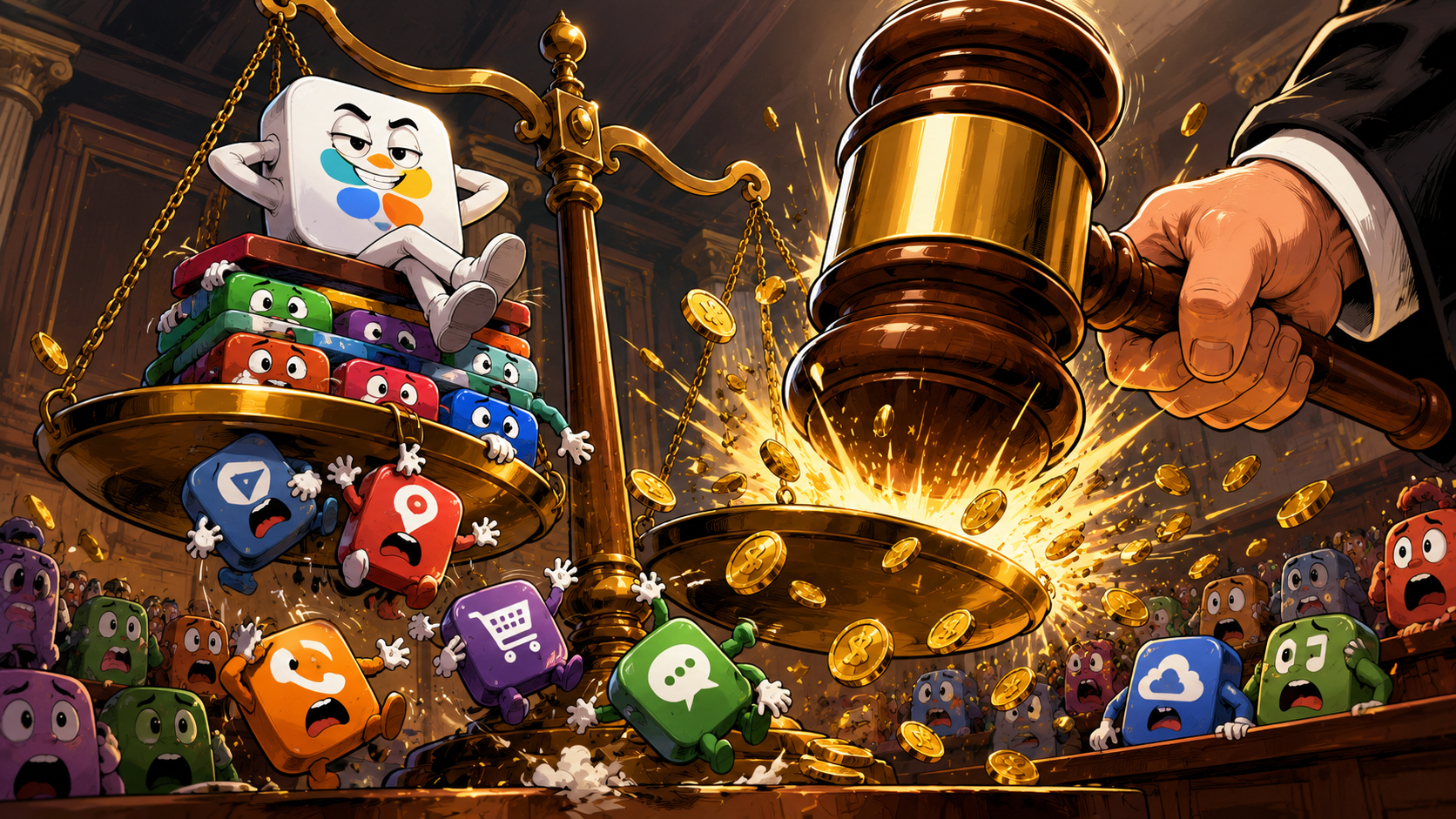
On 23 July 2026, the European Commission adopted two enforceable decisions against Google, imposing fines totaling €890 million for breaches of the Digital Markets Act. The headlines said "EU fines Google for favouring its own apps"—which is a shorthand for what happened, but the real story is more specific, and what it means for European users and app developers is both narrower and more immediate than the coverage suggests.
This decision is not about AI services. It is not the Android AI interoperability order we covered in July — that was a separate decision, taken a week earlier on 16 July 2026. This is a fine—money Google must pay—for two specific breaches of how it ranks its own services in Google Search, and how it restricts app developers from informing users about alternatives to Google Play.
Let me walk through what the Commission actually found, what it did not find, what the documents say versus what news reports claimed, and what this means if you use Google Search or distribute apps in Europe.
Two fines for two different breaches
The €890 million breaks down into two separate penalties:
- €460 million for self-preferencing on Google Search
- €430 million for anti-steering on Google Play Store
These are distinct violations under different articles of the DMA, with different remedies required.
The first breach: Google Search self-preferencing
Under the Digital Markets Act, a gatekeeper like Google must not "treat its own services more favourably in ranking" than third-party services appearing in the same results. This is Article 6(1)(a) of the DMA.
The Commission found that Google violates this. Specifically, Google gives preferential treatment to its own services—shopping, hotels, and others—in Google Search results. The press release states: "Google displays its own services more prominently in search results, including at the top of the search results page."
This is the kind of thing you might have noticed. If you search for a hotel in London, Google's own hotel comparison sometimes appears at the top or side before independent comparison sites. If you search for a product, Google Shopping often gets prominent placement. The Commission argues this is preferential treatment that violates the DMA.
Google was given a €460 million fine for this conduct. The remedy ordered: Google must treat third-party services that appear in Google Search results fairly and without discrimination.
The second breach: Google Play Store anti-steering
Under the DMA, app developers who distribute via Google Play Store must be able to inform customers about alternative offers and payment methods outside the Store. This is sometimes called "steering." Article 6(1)(b) of the DMA protects this right.
The Commission found that Google prevents this. Google's Play Store rules restrict app developers from freely communicating outside the Store about their own payment systems and offers. In effect, developers cannot tell users: "You can buy this from my website cheaper than through Google Play."
Google was fined €430 million for this conduct. The remedy ordered: App developers must be able to inform users about alternatives to Google Play, both technically and contractually.
What the decision does NOT say
Several claims from news coverage do not appear in the official Commission documents:
No penalty figure appears for "global revenue" or "turnover." The fine is simply €890 million in total. News outlets sometimes report fines as percentages of global turnover; this document does not calculate or state one.
No specific named competitor is mentioned as a beneficiary. The Commission uses the term "third-party services" and says developers should be able to steer users to "alternative offers." No company—OpenAI, Anthropic, Perplexity, or anyone else—is named as a beneficiary of these requirements.
No timeline for users to see changes. The Commission ordered Google to bring non-compliance to an end within 60 days of the decision (roughly by 22 September 2026). But "bringing non-compliance to an end" is a legal compliance deadline, not a user-facing launch date. Google will file new terms and compliance measures, but when users actually see a change in how Search ranks third-party services—or whether they notice it at all—is not specified.
No direct quote from Google is included in the Commission document. News reports quoted Google saying the decision would force them to "strip away real-time Search features Europeans love" and that "This isn't fair competition." These statements do not appear in the Commission's official press release or case summary. We cannot use them without having read them at source.
Google's appeal status is unknown. The press release says "Google may decide to appeal today's decisions." This is not a prediction or confirmation—it is a statement of Google's legal right. As of the date this article was written, no appeal had been publicly announced.
How this decision is different from the Android AI decision
The same Commission released two significant decisions in July 2026 regarding Google. We already covered the other one: /eu-google-android-ai-interoperability. It is important to understand that these are two separate cases.
The Android AI decision (16 July 2026) imposed binding specification measures requiring Google to open 11 Android features to rival AI services, with no fine attached. It is regulatory guidance backed by DMA enforcement authority.
This decision (23 July 2026) imposes monetary penalties (fines) for non-compliance with existing DMA rules about search ranking and app steering.
Both target Google's gatekeeping power. But one is about opening new interoperability obligations; the other is about enforcing existing anti-preferencing obligations. They have different legal bases, different remedies, and different implications for what Google must do next.
Do not conflate them. They are two decisions about two different forms of conduct.
What changes for European Search users
If Google complies with the Commission's order, the ranking algorithm for Google Search should change so that Google's own services no longer receive preferential placement.
This could mean:
- Hotel comparison results from independent sites appear with the same prominence as Google's own hotel results
- Product shopping results from Amazon or other marketplaces rank based on relevance, not Google ownership
- Flight results from independent travel sites are not deprioritized versus Google Flights
But this is conditional. Google must implement the change within 60 days. The Commission can impose periodic penalty payments if it does not. The exact shape of the new algorithm is not specified in the decision.
Also, users may not notice. A change in ranking order at position 2 versus position 3 in the search results might have no effect on user behaviour if most people click the first result anyway. The point is legal compliance, not necessarily a dramatic user experience shift.
What changes for app developers
App developers distributing apps via Google Play Store should gain the ability to steer users to external payment systems. This means:
- A developer can include a link or message inside the app saying "Subscribe on our website for a better rate"
- A developer can show users their own payment flow, not forcing them through Google Play
- A developer can communicate these alternatives without Google blocking the message
But again, this is contingent on Google implementing the required changes. And Google can still charge fees for serving as the initial distribution channel for new users—the DMA does not eliminate the Play Store fee structure, only the steering restriction.
What the timeline actually is
- 23 July 2026: Decisions adopted
- Approximately 22 September 2026: Compliance deadline (60 days)
- After that: Commission monitors compliance; if Google fails, periodic penalty payments can accrue
There is no user-facing launch date. There is no "new Google Search experience launches on X date." The decision is a legal order, not a product release.
The evidence gap
This article states what the Commission documents actually say. But several important questions remain unanswered in the publicly available sources:
- What exactly does Google's current algorithm do that violates the DMA? The decision says Google displays its own services "more prominently," but doesn't show the specific search results or queries where this happens. Is this a systematic bias, or a few high-traffic queries? We don't know.
- What will the new ranking algorithm look like? Google must fix it, but the Commission does not specify how. Google could weight its own services equally, or neutrally, or in some other way. We have no detail.
- Will Google appeal? We don't know. The Commission notes Google has the legal right to appeal, but no public statement to that effect has been found yet.
- Has Google already started changing its practices? The press release mentions Google "has proposed and started testing changes related to search ranking" and "has rolled out changes related to Google's steering terms." No dates or details are given.
These gaps are not omissions in this article. They are genuine gaps in what the Commission has made public, and they will shape how the decision actually plays out.
The precedent
This is the first time the European Commission has imposed monetary fines under the DMA against Google. The DMA came into force in November 2022. Google was designated as a gatekeeper in September 2023. The first regulatory findings came in March 2024 and March 2025. This July 2026 decision is where enforcement shifted from findings to fines.
It is a signal to other gatekeepers: the Commission is now prepared to use its fine authority to enforce the DMA's behavioral rules. For Google itself, it raises the stakes. The next enforcement action could carry a larger fine.
Why this matters
The DMA is one of the first laws to directly regulate gatekeeper power through behavioral requirements. This decision tests whether those requirements work—whether the threat of fines actually changes how Google ranks search results and how it treats app developers.
For European users, the practical effect may be small. A more level playing field in search results is theoretically good for competition, but you might not feel it in daily use.
For European app developers, the effect could be more tangible. An independent email app, weather app, or shopping app that can now tell users "our website has a better subscription rate" has a tool it lacked before.
For Google, it is a cost of operating in Europe. €890 million is significant, but not unprecedented for Google's fines in Europe. The bigger impact is the regulatory precedent: the Commission has shown it will fine gatekeepers for breach of the DMA's core rules.
Sources
All sources were accessed and read directly on 2026-07-24.
- https://digital-markets-act.ec.europa.eu/commission-fines-google-eur890-million-breaches-digital-markets-act-2026-07-23_en — Commission DMA portal announcement (HTTP 200, browser read)
- https://ec.europa.eu/commission/presscorner/detail/en/ip_26_1670 — European Commission press release IP/26/1670 (HTTP 200, browser read)
- https://www.bbc.co.uk/news/articles/cevmenngkzpo — BBC News coverage of the fine (HTTP 200, browser read)
- https://digital-markets-act.ec.europa.eu/index_en — DMA homepage with latest news section (HTTP 200, browser read)
- https://competition-policy.ec.europa.eu/ — EU Competition Policy main page (HTTP 200, browser navigation)
- https://digital-markets-act.ec.europa.eu/about-dma_en — About the Digital Markets Act (HTTP 200, browser read)
- https://digital-markets-act.ec.europa.eu/about-dma/legislation_en — DMA Legislation page (HTTP 200, browser read)
- https://digital-markets-act.ec.europa.eu/gatekeepers-portal_en — DMA Gatekeepers Portal (HTTP 200, browser read)
Publisher: Jin86 Contact: editorial@lifepivo.com