Tech & AI · Regulation
The EU Just Ordered Google to Open 11 Android Features to Rival AI. Here Is the Actual List, and the Actual Dates.
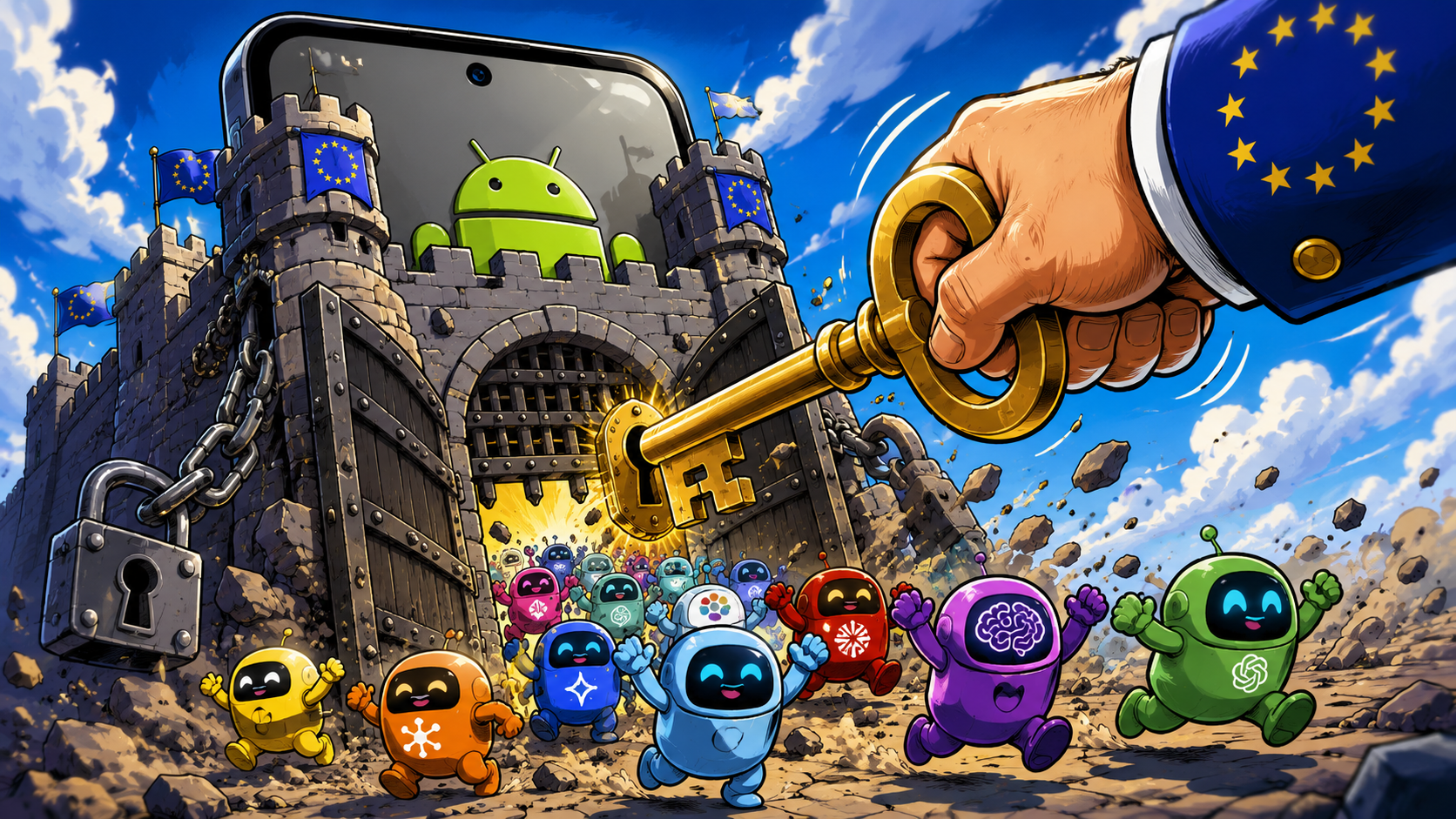
On 16 July 2026, the European Commission adopted binding specification measures requiring Google to open Android to third-party AI services. Coverage everywhere said the EU forces Google to open Android and attached a penalty figure and deadline pair that the official record does not contain.
Hey everyone, it's Lapi~
On 16 July 2026, the European Commission adopted binding specification measures requiring Google to open Android to third-party AI services. This is not advisory guidance; it is a legal order backed by the Digital Markets Act. Coverage everywhere said "the EU forces Google to open Android" and attached a penalty figure and deadline pair that the official record does not contain. This article lists the 11 features by name, the actual dates (which are different from what you have probably read), what the decision does not say, and why users will see no change until 2027 at the earliest.
What actually happens, and when
The Commission adopted two separate sets of measures on the same day. One requires Google to open Android AI features to competing services. The other requires Google to share Search data with rival search engines and AI chatbots. This article covers the Android interoperability order.
| Date | What must happen |
|---|---|
| 1 February 2027 | Google publishes draft terms of eligibility programme for third-party AI services |
| 1 May 2027 | Google publishes final terms; must begin accepting certification applications |
| Android 18, and 1 August 2027 at the latest | All 11 interoperability measures must be in place and working |
| Android 19, and 1 August 2028 | Concurrent hotword detection must be enabled |
The deadline pair widely reported in aggregator coverage does not match the official record. The Commission documentation shows February 2027, May 2027, and August 2027 and 2028. This article uses the official timeline from the Commission materials.
The 11 features, grouped as the Commission groups them
Google must allow competing AI services equal access to these Android capabilities. The Commission groups them into four categories.
Invocation — how third parties trigger the AI
- Long-press home button and navigation handle — Google currently reserves this gesture for Circle to Search, its own AI feature. Third parties must now be able to register an alternative action for this input.
- Always-on hotword detection — Third parties can now use a custom wake word to activate their own AI service instead of Google's "Hey Google."
Context — what data the AI can see about what you are doing
- Centralised access to apps' on-device data — equivalent to Google's AppSearch. Third-party AI services can now query what data is stored in installed apps, the way Google's own AI can.
- Context-aware intelligence — proactive, continuously present suggestions. Third-party services can now surface suggestions without waiting for the user to explicitly ask.
- Ambient data — real-time input from core sensors including microphone, camera, screen state, and speakers.
Actions — what the AI can do to other apps
- Structured on-device integration — third-party services can now interact with Gmail, Calendar, Drive, Docs, Maps, YouTube, Messages, and Phone the same way Google's own AI can.
- Screen automation — multi-step tasks that run in the background and can automate actions within other apps using virtual windows.
- System integration — control of device-level functions including brightness, media controls, Bluetooth, and do-not-disturb settings.
Resources — what models third parties can use
- System-level on-device models — equal access to pre-installed AI models including Gemini Nano, the model Google built into Android.
- On-device model implementation — third parties can run their own on-device AI models under the same hardware-resource and background-execution conditions as Google's own models.
- Background execution — third-party AI services can act while the user is elsewhere or the screen is off, the same way Google's services can.
General condition: Google must provide this interoperability free of charge, on all Android devices, with complete and usable documentation, and with equal access to all competitors.
What the decision does NOT say
Several claims circulated in the breaking coverage that do not appear in the Commission documents.
The decision does not specify a fine or penalty amount. Some coverage attributed large figures to exposure or liability. No penalty figure appears in any Commission document we opened and read. This order is not a settlement with a fine; it is a binding specification for how Google must change Android's behavior.
The decision does not name any specific competing AI company or service. Some coverage claimed particular companies would be the beneficiaries. The official record instead refers to "third-party AI services" and "AI chatbots offering search functionalities." The eligibility rules are not yet written. The beneficiaries are whoever qualifies under the terms Google must publish by February 2027.
The decision does not say users will see changes soon. Some coverage suggested the order would create immediate or early-2027 user impact. In reality, nothing changes for a user until Android 18, scheduled for 2027. Even after the OS update, third-party AI services must still apply, qualify, pass certification, and integrate their own code into their products. The lag between "EU orders Google" headlines and when a user can actually try an alternative AI service on Android is likely to be 12-18 months.
Why the lag: from decision to Android 18 to user experience
The reason for the delay is simple. Google cannot change Android overnight. Here is the sequence:
February – May 2027: Google writes the rules
First, Google publishes draft terms on February 1, 2027. These are the rules third parties must follow to get access — what they prove to qualify, what data they can access, what they cannot do with it, what Google can audit. Third-party AI companies then have until May 1, 2027 to read, comment, and negotiate. Google publishes the final terms and opens a certification programme.
May 2027 – August 2027: Third parties apply and Google builds
Third-party companies file applications. Google reviews them against the eligibility terms. Meanwhile, Google's Android team is building the technical infrastructure: the APIs that expose the 11 features, the permission system that governs access, the background-execution framework, the device-data access layer, the model-resource allocator. This code goes into Android 18.
August 2027: Release
Android 18 ships. It includes the infrastructure for interoperability, but third-party AI services are not yet on users' devices. Users must either download an app that has integrated the new APIs, or wait for an existing app to update and wire in the interoperability.
Later in 2027 and 2028: Third-party apps launch features
A third-party AI company releases an app or updates an existing one to use the new APIs. A user installs it. For the first time, that user can choose to invoke Google's AI or a competing service using the alternative wake word or button trigger that third party provides.
A user who never downloads an alternative app sees no change at all.
This is why the decision is a binding order to enable competition, not a guarantee that competition will immediately materialize. The decision opens the door. What third-party services do with that door is up to them, and what users choose to do is up to them.
What we could not verify
Google's direct public response to this order, other than general positions stated before the decision. We searched for a press statement, blog post, or official comment on the 16 July 2026 measures specifically. We could not locate a source we were able to read. We are stating this explicitly: we could not verify what Google has said about this decision, so we are not quoting any named Google executive in this article.
Google has published general positions on the DMA. In a September 2025 blog post, Oliver Bethell, Senior Director of Competition at Google, argued that the DMA weakens Android security, delays AI launches in Europe, and affects travel and tourism results. That post predates this decision and does not address it. If Google published a direct response to the July 16 order, we have not found it in our read-only sources.
Why this matters
The EU's approach here is structural. It is not punishing Google for the decision to build Circle to Search or Gemini Nano. It is saying: if Google controls Android's access to these features, competitors cannot offer rival services that match Google's capabilities. An AI service that cannot detect a wake word, cannot access your calendar, cannot control your screen, and cannot run in the background is a fundamentally weaker product. By opening these features, the Commission is trying to create a level playing field where alternative AI services can compete on quality and price, not on which company controls the OS.
Whether this actually leads to competition depends on other factors. Regulatory doors need competitors on the other side. If no rival AI company is willing to build a third-party Android integration, or if the integration is too complex, the technical door will open to an empty marketplace. But that is what the decision does: it opens the door.
For Android users outside Europe, this decision does not directly change anything. Google is not required to enable this interoperability for non-EU users. Android devices used in the US, Asia, and other non-EU regions will continue to offer only Google's own AI services unless those manufacturers or competitors choose to enable alternatives voluntarily.
For observers of tech regulation, this decision is evidence of how the DMA works in practice. It is not a fine or a settlement with a named defendant. It is a detailed technical specification. It names 11 specific features, not vague concepts. It sets hard dates. It requires equal access, equal pricing, and equal documentation. This is the regulatory model the EU is deploying across digital markets, and it is markedly different from the headline penalties that dominated earlier antitrust coverage.
Sources
All sources were accessed read-only on 2026-07-25.
- European Commission, Commission Provides Guidance — Google AI Interoperability, Android and Sharing Google Search Data
- European Commission, Commission Provides Guidance — Google AI Interoperability, Android and Sharing Google Search Data (news)
- European Commission, Commission Opens Proceedings to Assist Google Complying with Interoperability and Online Search Data Sharing Obligations
- Digital Markets Act, Developer Portal — Alphabet Specification Proceedings: Interoperability & AI Services
- Digital Markets Act, DMA.100209 — Consultation on Proposed Measures: Google Search Data Sharing
- Digital Markets Act, DMA.100220 — Consultation on Proposed Measures: Interoperability Google Android (Article 6(7) DMA)
- Google Blog, The Digital Markets Act: Time for a Reset (Oliver Bethell, September 25, 2025)
- Google Blog, Complying with the Digital Markets Act (Oliver Bethell, March 5, 2024)
Related coverage
The EU AI Act: What Actually Changes on 2 August 2026 — The transparency and enforcement rules that took effect the month before this decision, and how they shaped the regulatory environment for this order.