Why Can't You Hear the Dialogue on Your TV Anymore? It Is Not Your Ears - It Is Physics, Mixing and a Speaker the Size of a Coin
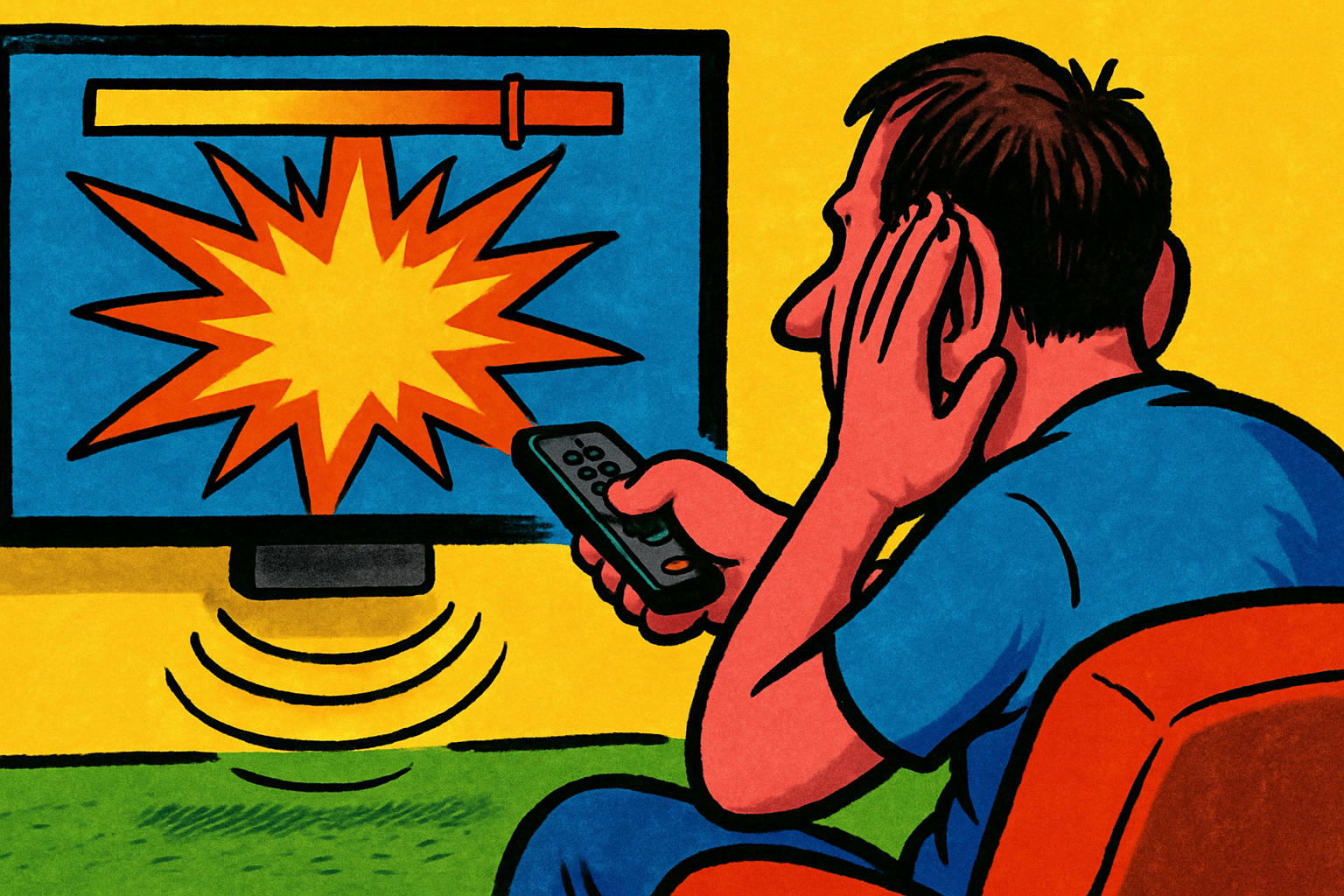
You know the move. A character says something that clearly matters, you miss half of it, and your thumb is already on the volume button. Ten seconds later an explosion or a swell of music nearly blows you off the sofa, so you turn it back down, and now the next line is a mumble again. Somewhere in that loop most of us have just given up and switched the subtitles on, even though our hearing is fine.
If that is you, here is the first thing worth knowing: it is mostly not you. The reasons TV dialogue has become so hard to follow are physical, technical and industrial, and once you can see them, the fixes stop feeling like guesswork. This is the explainer version - what is actually going on, what genuinely helps, and which of the popular explanations I could stand up from a real source and which I could not.
The screens got thinner, and the speakers paid for it
Start with the hardware, because it is the part people least suspect. A modern flat television is a design triumph and an acoustic compromise. There is almost no depth to work with, which means there is almost no room for a decent speaker or the sealed cabinet a speaker needs to move air and make a voice sound full. So the speakers shrank, and just as importantly, they got moved out of your line of fire.
Lauren Ward, an audio-engineering researcher at the University of Salford who has written about exactly this, points out that the speakers in many sets are positioned so they "point downwards or even backwards." Your TV is often firing its sound at the floor, the wall or the cabinet it is standing on, and you are left with whatever bounces back. Voices, which live in the higher and more directional part of the sound, lose out the most in that reflection.
The bigger technical culprit Ward describes is frequency response - how loud a speaker plays different pitches relative to each other. A study she cites found that the frequency responses of different television sets varied by 10 to 20 decibels. That is a large gap. In plain terms, it means some TVs pump out the low, rumbling background sounds far louder than intended while leaving the higher-pitched frequencies that carry human speech untouched. The rumble comes up, the voice stays put, and the dialogue drowns.
Ten to twenty decibels is not a subtle difference you have to strain to notice. It is the difference between a mix the makers balanced carefully in a studio and the muddy version that actually reaches your ears, decided not by the director but by which cheap driver a manufacturer bolted into the back of the panel.
The mix was made for a room you are not sitting in
The second problem is that the soundtrack you are hearing was very likely not balanced for a pair of coin-sized speakers firing at your carpet. High-end film and drama audio is built with a wide dynamic range - a big gap between the quietest whisper and the loudest bang - because on a proper system that range is thrilling. Squeeze that same mix through a thin TV and the gap works against you: the loud parts are still loud, but the quiet dialogue sinks below the point where a small speaker can render it clearly.
That is the deeper meaning of the frequency and placement problems above. There is no single mix that is right for everyone, because a living room with a flat TV, a cinema, and a good pair of headphones are three completely different acoustic worlds. Ward's own conclusion is that this is not a fault to be blamed on one lazy sound engineer - it is a structural mismatch, and the honest fix is not a better fixed mix but a mix you can adjust yourself. Hold that thought, because the industry has started building exactly that.
Your brain was doing more of the work than you realised
Here is the part that surprises people. A good chunk of "hearing" dialogue is not hearing at all - it is prediction. Ward describes a "familiar talker advantage": we understand speech noticeably better when it comes from a voice we know, even one we have only recently started listening to. It is part of why a show gets easier to follow a few episodes in, and why a brand-new character in a brand-new drama can be a wall of mush.
Context does even more. When we have language or content cues to lean on - we know roughly what the scene is about, so we know what words are plausible - we recognise speech about twice as accurately, even in the most challenging listening conditions. That is a huge effect. It means the same muddy line is intelligible in a familiar, predictable scene and impossible in a confusing one, with no change in the audio at all.
Accent plays in too. Research Ward points to found that some accents are simply harder for listeners to understand than others, regardless of where the listener is from. So when you struggle with a specific actor in a specific regional drama, you are not imagining it, and it is not snobbery - it is a measurable feature of how speech perception works. Put these together and you get the maddening inconsistency everyone recognises: some shows are fine, some are a fight, and the difference is not only in your speakers.
This is an accessibility problem, not a fussy preference
It is tempting to file all this under first-world grumbling. That would be a mistake, because for a very large group of people the mumbling is not an annoyance, it is a locked door.
The UK charity RNID, which works on hearing loss, runs a long-standing campaign called Subtitle It, and its numbers are stark. In its Subtitle It survey, nine in ten respondents with hearing loss said they usually or always use subtitles when watching TV. Ninety-seven per cent said they had tried to watch a programme and found there were no subtitles at all. Seventy-one per cent said they had felt left out of conversations with friends or family because they had missed out on something for lack of subtitles. RNID also estimates there are around 87,000 deaf British Sign Language users in the UK - one slice of a far larger population that relies on captions and clear audio to take part.
The system has been slowly forced to improve. RNID says that when the campaign began about a decade ago, roughly 80% of regulated UK on-demand services provided no subtitles. The Media Act 2024 finally set legal minimum quotas for subtitles, audio description and sign language on on-demand services, and by 2024, 94.7% of on-demand providers who reported their figures were offering subtitles. Progress - but RNID is clear that subtitles are still missing in plenty of places, particularly live events, breaking news and some subscription platforms. The point stands: when dialogue is hard to hear, the people it shuts out first are the people who could least afford to lose it.
The fixes that actually exist
The good news is that this is one of those rare problems where the remedies are real, cheap and mostly already in your house.
The most reliable fix is the least glamorous: turn the subtitles on. They are free, they are on almost everything now, and there is no shame in a tool that nine in ten people with hearing loss already depend on.
Next, look for a dialogue or speech-clarity mode. Many TVs and nearly every soundbar now ship with a setting that lifts the frequencies where speech lives and pulls back the boom, which directly counters the frequency-response problem described above. A soundbar in particular is the single biggest hardware upgrade for the money, precisely because it undoes the "coin-sized speaker firing at the floor" design of the panel.
Some streaming services have gone further and built the adjustable mix Ward argued for. Amazon's Prime Video has a feature called Dialogue Boost that raises the volume of dialogue relative to the music and effects. Crucially, Amazon describes it as a targeted enhancement - it uses AI to find the moments where speech is getting buried and lift just those, rather than turning everything up. It offers Medium and High levels, and while Amazon says it was built with hard-of-hearing viewers in mind, anyone can switch it on. (I am not putting a launch date on it, because Amazon's own page does not give one and I could not verify a date from a source I actually opened.)
The most interesting fix: let the viewer move a slider
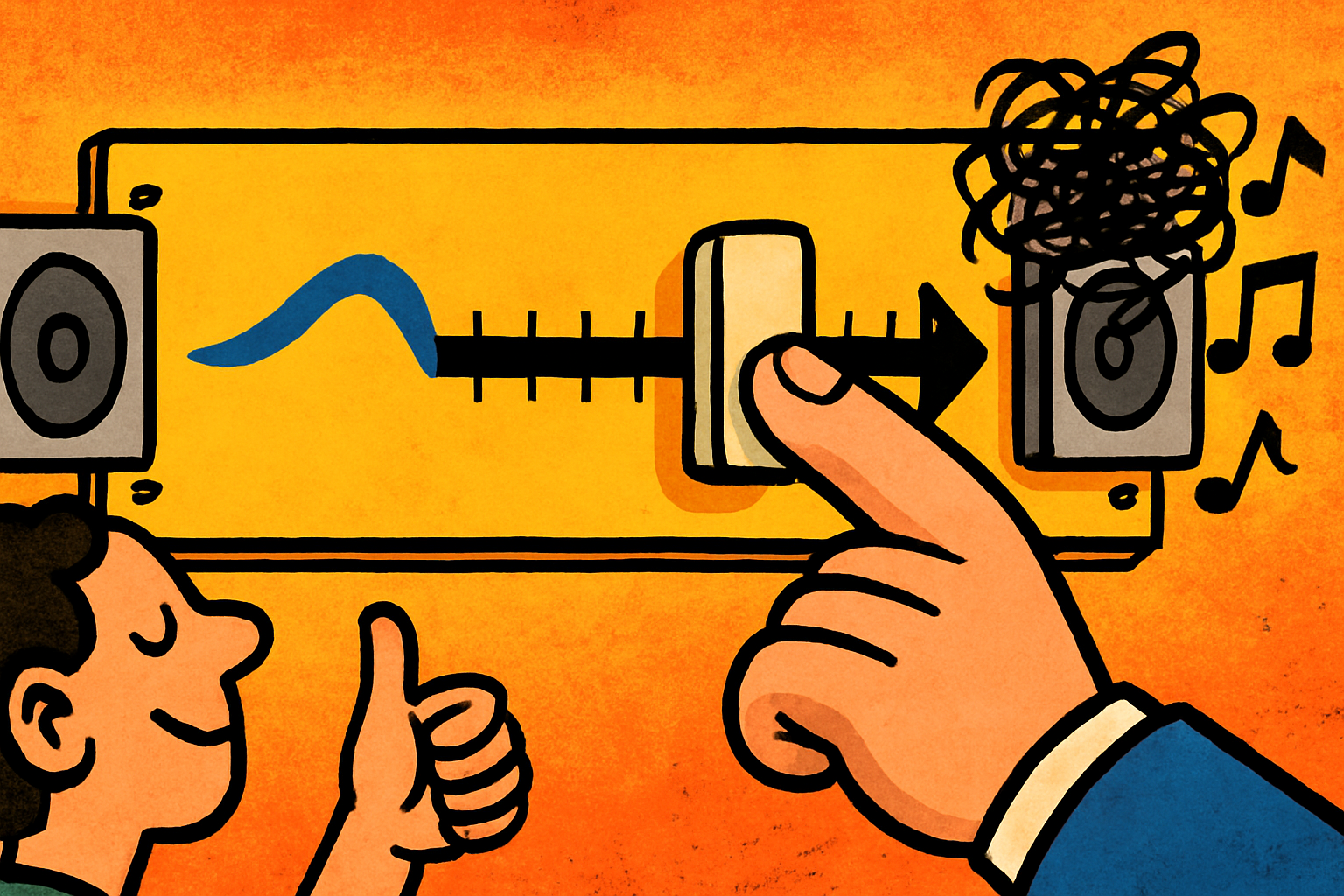
The real future here is called object-based audio, and the BBC has already put it in front of the public. Instead of sending one finished, pre-mixed soundtrack, object-based audio sends the ingredients separately - dialogue, effects, music - each with instructions on how to combine them. That means the balance can be decided at your end, not baked in at theirs.
In June 2019, engineers at the University of Salford worked with BBC R&D to trial this on an episode of the drama Casualty. Viewers got a single slider. As Lauren Ward explained it: "At the right-hand side of the slider, you get the same mix as heard on TV. At the left, the dialogue is enhanced and some of the other sounds are quieter." One control, and you dial in as much clarity as you personally need - no more, no less. (The trial reported strong results; I have seen a specific satisfaction figure quoted for it, but I could not confirm that number from a source I actually read, so I am leaving it out.)
The research backs the instinct. A separate study by Davide Straninger on dialogue enhancement in object-based audio, focused on listeners over 65, found that giving people control raised their satisfaction, and that older viewers consistently preferred a bigger gap between speech and background than the original mix gave them. In other words, the "default" mix is quietly wrong for a lot of people, and letting them adjust it is not a gimmick - it measurably helps.
Why hasn't a regulator just fixed this?
People often assume there must be a rule forcing broadcasters to make dialogue audible. There is a loudness rule, but it solves a different problem. In the United States the CALM Act, implemented through a technical standard called ATSC A/85, exists to stop commercials being jarringly louder than the programmes around them. It works by measuring loudness with a standard method and storing that value as metadata so playback levels can be normalised.
But read what it actually governs: the loudness of commercials relative to programmes. It says nothing about the intelligibility of dialogue inside a programme, and it does not reach streaming at all. So the law that people vaguely remember as "the anti-loud-TV law" was never aimed at the mumbling problem, and could not fix it even if it wanted to. That gap - regulated commercial loudness, unregulated in-show clarity - is a big part of why the issue has festered for years.
The honest bottom line
Strip out the folklore and here is what holds up. Your TV's speakers really are tiny, badly aimed and wildly inconsistent from set to set, to the tune of a 10-to-20-decibel swing. The mixes really are built for rooms you are not sitting in, with a dynamic range your panel cannot serve. And a real share of "hearing" is your brain predicting words from familiar voices and context, which is why some shows fight you and others do not.
What I would not repeat without a source in front of me: any exact launch date for Dialogue Boost, any specific satisfaction percentage or headcount for the Casualty trial, and the precise loudness target and start date of the CALM Act. Those figures are floating around; I could not open a page that stood them up, so they are not in this piece.
The practical version is short. It is not your ears. Turn on subtitles, find the dialogue mode, and if you can, add a soundbar - and know that the proper fix, a mix you control with a single slider, has already been tested on real broadcast television and works. The industry built the problem into the hardware and the mix. It is slowly, finally, building the way out.
Sources
- Lauren Ward (University of Salford), "Speak up! Why some TV dialogue is so hard to understand," The Conversation (2017): https://theconversation.com/speak-up-why-some-tv-dialogue-is-so-hard-to-understand-75423
- The same article on phys.org, dated 27 April 2017, used to confirm author, date and the 10-20 decibel figure: https://phys.org/news/2017-04-tv-dialogue-hard.html
- Amazon, "Prime Video launches a new accessibility feature that makes it easier to hear dialogue" (Dialogue Boost), Amazon newsroom: https://www.aboutamazon.com/news/entertainment/prime-video-dialogue-boost
- University of Salford, "Salford improves audio on BBC Casualty" (object-based audio trial, dated 7 August 2019): https://www.salford.ac.uk/school-of-science-engineering-and-environment/salford-improves-audio-on-bbc-casualty
- Davide Straninger, "Dialogue Enhancement in Object-based Audio - Evaluating the Benefit on People above 65," arXiv 2006.14282: https://arxiv.org/abs/2006.14282
- RNID, "Facts and statements on inclusion" (Subtitle It survey figures): https://rnid.org.uk/what-we-do/data-and-evidence/inclusion-facts/
- RNID, "10 years of Subtitle It! - creating change together" (Media Act 2024 and the 94.7% figure), October 2025: https://rnid.org.uk/2025/10/10-years-of-subtitle-it-creating-change-together/
- meterplugs, "CALM Loud Commercials with ATSC A/85" (what the loudness rule covers): https://www.meterplugs.com/blog/2017/07/11/calm-loud-commercials-with-atsc-a-85.html