When PlayStation Network Went Dark for an Evening: What Actually Happened, and the Bigger Question It Raised About an All-Digital Future
Verified 2026-07-27. This piece is built only from sources we opened and read: the BBC's report, Engadget's running coverage, Sony's own PlayStation Service Status page, and Sony's July announcement about physical discs. Where a fact came from a third-party tracker or a single outlet, we say so. Where something is simply not known — including what caused the outage — we say that too.
What happened, in one paragraph
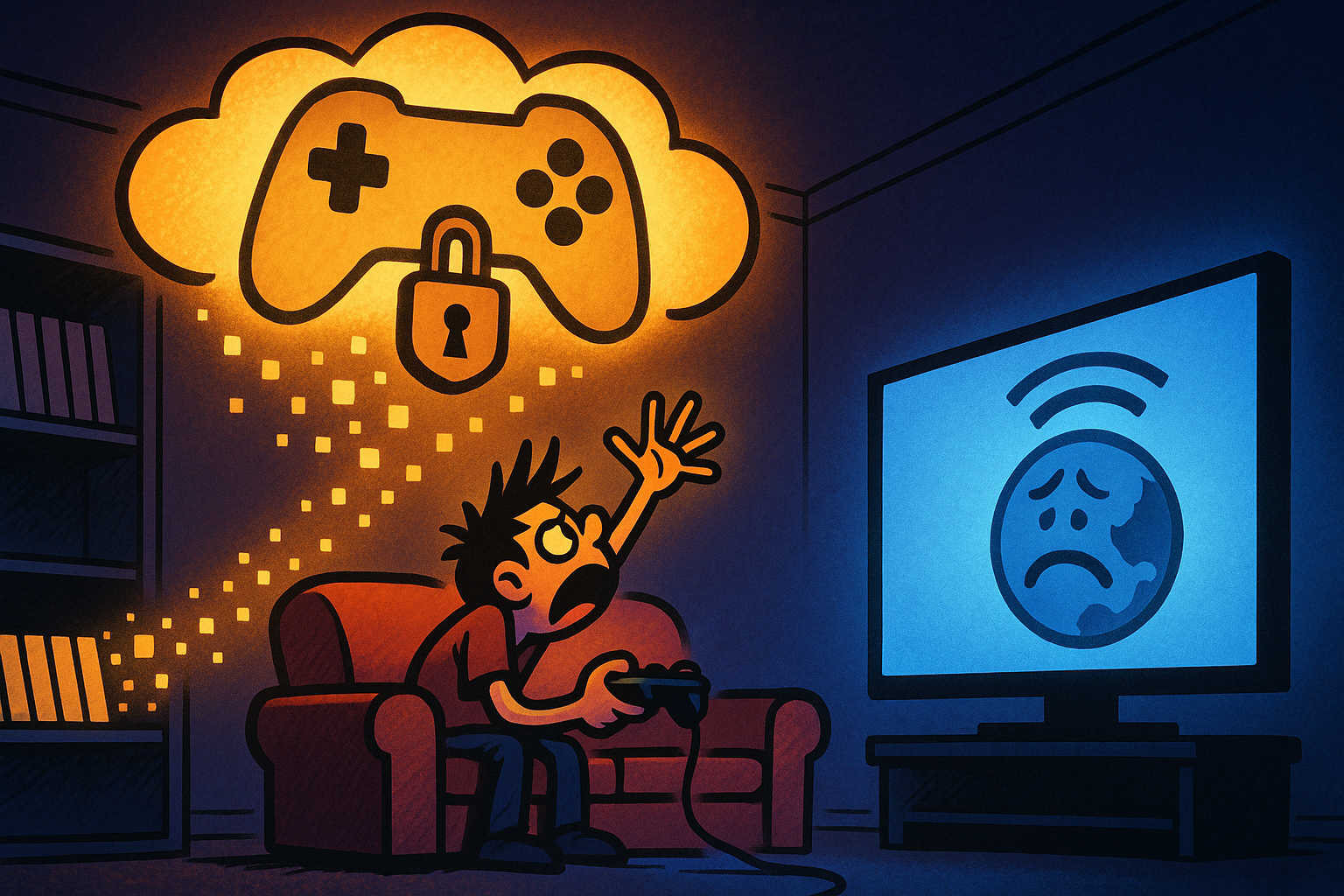
On Friday 24 July 2026, PlayStation Network — the online backbone that lets a PlayStation sign in, launch digital games, join multiplayer matches and buy from the PlayStation Store — stopped working for a large number of players around the world. For a few hours, "your library is right there but you can't open it" was the shared experience across North America, Europe and Asia. By Friday evening, Sony's status page showed every affected service back to normal. Sony has not said what went wrong.
That is the whole confirmed story. Everything else worth writing is either context around it or an honest account of what nobody has confirmed yet.
What was actually affected
The BBC, whose technology reporter Laura Cress covered the outage, described it plainly: the disruption "affected gamers' ability to launch games, apps or network features on their PlayStation."
Engadget, reading Sony's own PlayStation Service Status page as it updated, went further and listed what the page itself flagged. The status page said "all services are experiencing issues," and Engadget enumerated them: account management features, game streaming, the PlayStation Store, and even PlayStation Direct — Sony's website for selling PlayStation hardware. In other words, this was not one feature stumbling. The sign-in layer that nearly everything else depends on was unwell, and the symptoms fanned out from there.
Engadget also noted the reach across hardware generations: the problems touched not just current consoles but "older platforms the company is still maintaining in one way or another, like the PS Vita, PS4 and PS3." If you owned almost any PlayStation that talks to the internet on Friday, you may have felt it.
There was at least one concrete, non-living-room consequence. According to Engadget, the outage delayed the EA Sports FC 26 championship at the Esports World Cup — a reminder that when a consumer network goes down, it can take a professional competition with real stakes down with it.
How big was it, really?
This is where careful wording matters, because it is exactly the kind of number that gets rounded up until it stops being true.
The figure in circulation comes from Down Detector, a third-party service that tracks user-submitted outage reports. Per the BBC, Down Detector logged "tens of thousands of people" reporting problems globally with the service on Friday.
Read that precisely. "Tens of thousands of reports on one tracker" is a measure of how many frustrated people went looking for confirmation that it wasn't just them. It is not a Sony figure, and it is not a count of how many accounts were actually unable to connect — that number has not been published by anyone. The real total could be larger or smaller. We are stating what the tracker showed and stopping there.
How long, and how it ended
The BBC's timeline is coarse but reliable: the outage lasted "for hours," and "by Friday evening, all affected services were up and running, according to Sony's status page."
Engadget's coverage, updated through the evening, put a rough bracket on it: "over six hours after the outage began, that page showed things had returned to normal," with the outlet's final update stamped 24 July, 7:45 PM ET. Engadget also flagged the recovery as slightly bumpy — "some anecdotal complaints online said there were some teething issues in recovery" — before concluding that, by most accounts and its own checks, things were back to normal. Android Authority and Fingerlakes1, which both tracked the day live, described the same arc: an outage that appeared out of nowhere in the afternoon, and a staggered recovery in which "some players will have full access back right away and some will continue to have delays."
Notably, the fix arrived without a public explanation of what went wrong. Sony's acknowledgment was minimal: Global News reported that PlayStation posted "We are aware some users might be currently experiencing issues with PSN" on its social channels, while Engadget noted that early on Sony "has yet to publicly acknowledge the PSN outage on its public-facing PlayStation Support account," updating chiefly through the Service Status page. The BBC, for its part, said simply: "The BBC has approached PlayStation for comment." A short "we're aware" note is not the same as an explanation of cause — and no explanation of cause came back.
What caused it? Nobody has said — and one coincidence is not an answer
Here is the fact most likely to be mangled in retellings, so we will be blunt: no cause has been confirmed.
The one thread reporting offers is a timing coincidence. The BBC wrote that the PlayStation problems "began to appear around the same time as an alert from Amazon Web Services that some servers were facing issues, which was earlier resolved." That is a note about two things happening around the same clock hour. It is not Sony saying AWS was responsible, and it is not AWS saying it took PlayStation down. Big online services share infrastructure and dependencies in ways outsiders can't see from the outside, and "these two events overlapped" is a lead for someone to investigate — not a conclusion to publish. Until Sony explains what happened, the honest answer to "what caused it?" is: unknown.
Confirmed vs. reported vs. unknown
The most useful thing we can hand you is a clean line between what is nailed down, what rests on a single outlet or tracker, and what is genuinely open.
| Question | Confirmed | Reported (attribute it) | Still unknown |
|---|---|---|---|
| Was there an outage? | Yes — BBC and Engadget both reported it; Sony's status page showed services impaired then restored. | — | — |
| What broke? | Sign-in, launching games/apps, network features (BBC). Status page: "all services are experiencing issues" (via Engadget): account management, game streaming, PlayStation Store, PlayStation Direct. | Impact on PS Vita, PS4 and PS3 as well (Engadget, reading the status page). | The exact internal component that failed. |
| How many were affected? | — | "Tens of thousands" of reports on Down Detector (BBC). A report count, not an account count. | The actual number of players who could not connect. |
| How long? | "For hours"; restored by Friday evening (BBC). | "Over six hours" from start to normal (Engadget). | The precise start and end times. |
| What caused it? | Nothing confirmed. | BBC notes the problems appeared around the same time as an AWS server alert that was later resolved — a timing coincidence, not a cause. | The actual cause. |
| Did Sony explain or make good? | No public explanation found. | Sony updated only via the status page, not its support account (Engadget); BBC approached PlayStation for comment. | Whether Sony will say anything at all. |
| Any real-world fallout? | — | The EA Sports FC 26 championship at the Esports World Cup was delayed (Engadget). | Other disrupted events or tournaments. |
If you take one thing from this table, let it be the middle column. Most of what people "know" about an outage like this actually lives there — reported by one source, worth repeating with its name attached, and not the same thing as confirmed.
Why a routine-sounding outage touched a nerve
Networks hiccup. What made this one resonate beyond the usual Friday-night grumbling was timing of a different kind — not the AWS overlap, but where Sony is heading.
On 1 July 2026, Sony's PlayStation.Blog announced that physical game discs are on the way out. In its own words: "physical game disc production for all new games releasing on PlayStation consoles will be discontinued starting January 2028. Following this date, new games will be available on PlayStation Store and at retailers in digital formats only." The post framed it as following the customer: "In response to shifting trends in consumer preference, new games will be released on PlayStation Store and at retailers in digital formats only." Sony added that the change "has no impact on games that already released, or will be releasing, prior to January 2028 in disc format."
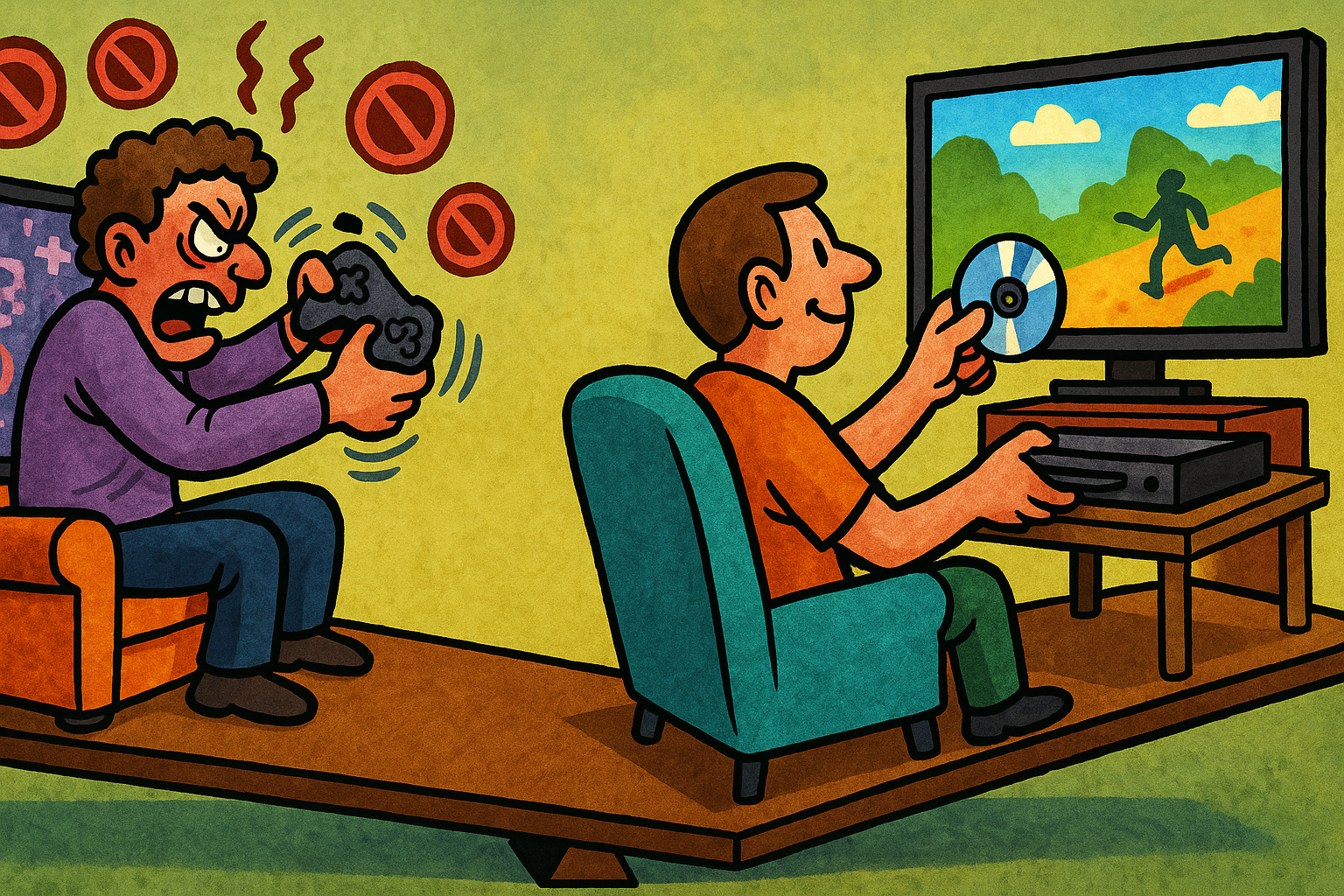
Set that plan against Friday's experience and the friction is obvious. When your games live on a disc, a network outage is an annoyance — you lose online play, but you can still put the disc in and start a single-player session. When your games live as licences tied to an account, and the account layer goes down, the library you paid for is temporarily out of reach. The BBC captured the mood with one comment it quoted from X: "Can't play digital games till you fix it. Yet I can put my disc in and play. The all digital future looks great."
That is not a knock-down argument against digital — the convenience of never hunting for a disc is real, and Sony is reading a genuine shift in how people buy. But it is a fair question, and an outage is exactly the moment people ask it: in an all-digital library, uptime stops being a nice-to-have and becomes the thing that decides whether you can play at all.
What we're deliberately not telling you
To keep this honest, here is what we left out on purpose:
- A cause. None was confirmed. We will not name AWS, a cyber-incident, or anything else as the reason.
- A precise victim count. "Tens of thousands of reports on Down Detector" is the only sourced figure, and it is a report count, not an account count.
- Any gesture to players. We found no announcement that Sony offered affected players anything in return, so we are not implying one exists.
- Historical comparisons with hard numbers. PlayStation Network has stumbled before, but we did not re-verify past figures this cycle, so we are not quoting them from memory.
If Sony publishes a post-incident explanation, those gaps are where the real story would fill in — and we will update.
The takeaway
For most players, Friday 24 July 2026 was a lost evening that fixed itself: sign-in and the store wobbled worldwide for a few hours, an esports final slipped, and by nightfall the status page was green again. No cause, no official explanation, no drama beyond the inconvenience.
The lasting part isn't the outage — it's the question it sharpened. Sony has told us where consoles are going: digital-only for new games from 2028. A few hours of downtime is a small preview of what "your whole library depends on the network being up" feels like. That is worth remembering the next time the little "can't connect" icon appears.
A question for you
If your PlayStation library goes fully digital, does a few hours of downtime change how you feel about buying games as licences rather than discs — or is the convenience worth it? We'd genuinely like to know which way you land.
Sources and verification
Directly-read sources (each opened 2026-07-27, all returned HTTP 200):
- BBC (Laura Cress), "PlayStation Network outage resolved after thousands of gamers unable to play" (24 July 2026) — https://www.bbc.co.uk/news/articles/cx2j0wy1gl5o
- Engadget, "PlayStation Network experienced a massive outage" (24 July 2026) — https://www.engadget.com/2222672/playstation-network-is-down-massive-outage/
- Android Authority (Oliver Cragg), "Is the PlayStation Network down for you? Here's what's going on" (24 July 2026) — https://www.androidauthority.com/playstation-network-july-24-outage-3691238/
- Global News, "Sony PlayStation Network outage enrages gamers around the world" (source of the PlayStation social-media acknowledgment quoted above) — https://globalnews.ca/news/11010521/playstation-network-status/
- Fingerlakes1, "PlayStation Network Restores Service Worldwide as Gamers Can Finally Get Back Online" (25 July 2026) — https://www.fingerlakes1.com/2026/07/25/playstation-network-restores-service-worldwide-as-gamers-can-finally-get-back-online/
- Sony, PlayStation Service Status (the channel that showed services impaired, then restored) — https://status.playstation.com/en-us/
- Sony, PlayStation.Blog, "Physical disc production ending in January 2028 for new games releasing on PlayStation consoles" (1 July 2026) — https://blog.playstation.com/2026/07/01/physical-disc-production-ending-in-january-2028-for-new-games-releasing-on-playstation-consoles/
- Game Informer (Marcus Stewart), "PlayStation Will Cease Production Of Physical Discs For New Games In January 2028" (1 July 2026) — https://gameinformer.com/2026/07/01/playstation-will-cease-production-of-physical-discs-for-new-games-in-january-2028
Attributed third-party data:
- Down Detector outage-report figures ("tens of thousands" of reports), as cited by the BBC. A count of user reports on one tracker, not a confirmed count of affected accounts.
Internal LifePivo links for follow-up:
/eu-ai-act-august-2026/— how regulators are approaching the digital services and platforms consumers increasingly depend on
Editor's note
This article reflects public reporting and Sony's own status updates as of 27 July 2026. Sony had not, as of the sources we read, published an explanation of what caused the outage. If an official post-incident account appears, LifePivo will update this piece. We have deliberately stated no cause, no victim count beyond an attributed report figure, and no gesture to players, because none of those was confirmed.
Contact: editorial@lifepivo.com