A UK Comic-Con Promoter Just Banned Meta's Smart Glasses. The Reason Is Uglier Than a Camera Rule, and It Splits the Disability Community.
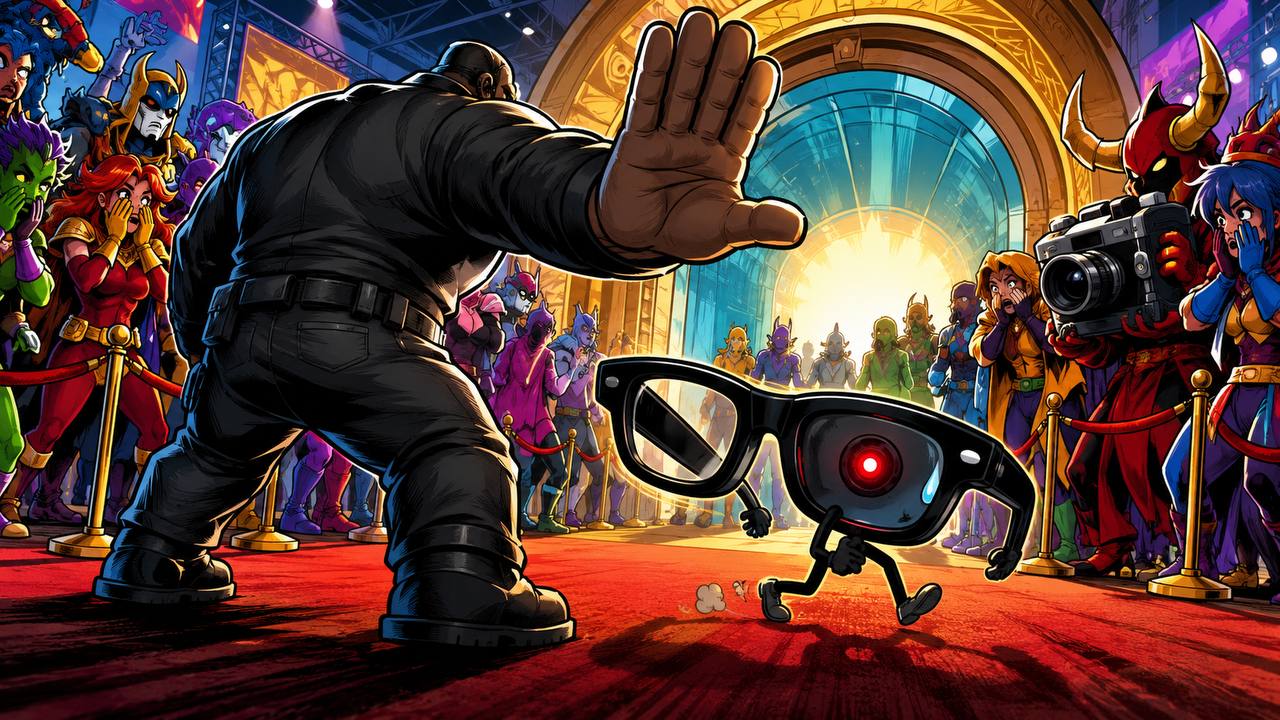
One of Britain's biggest comic convention promoters has told fans they can no longer wear Meta's smart glasses at its shows. On the surface it reads like the sort of housekeeping notice every large event issues, somewhere between the ban on selfie sticks and the ban on outside food. It is not. The stated reason is that people were being filmed without knowing it, and the guests being filmed said they would rather not come back. That is a different kind of rule, and it lands the convention world in the middle of an argument that has been building around these glasses for months.
Here is what was actually announced, what the phrase "secret filming" is standing in for, and the part that makes this genuinely hard rather than obvious: the same glasses that a stranger can use to record you without a word are, for some blind and partially-sighted people, the thing that reads a menu aloud or describes the room. Banning the device does not sort the good use from the bad. It removes both.
What the promoter actually did
The promoter is Monopoly Events, a UK company that runs Comic-Cons in Edinburgh, Aberdeen, Manchester, Liverpool, Birmingham and the north east of England, along with separate events built around professional wrestling, horror and anime. According to the BBC's report by Jonathan Geddes, the company has banned Meta glasses and any other wearable recording devices from its events.
The reason Monopoly Events gave, as reported, is not abstract. A number of the guests who appear at its shows told the company they had been recorded without their knowledge, and said they would be reluctant to keep appearing at Comic-Con events if it kept happening. At these conventions the guests are the product: actors, wrestlers, artists and other talent who sit for paid autographs and photographs. If they stop coming, the show has nothing to sell. So this is not a promoter reacting to a vague public-relations worry. It is a promoter reacting to the people it pays to show up.
The enforcement, again per the BBC, is blunt. Anyone caught using one of these devices can be asked to leave the event, and can forfeit any autographs or photographs they had already paid for but not yet collected. That is a real financial penalty, not just a stern word at the door.
A note on precision, because it matters here. Monopoly Events published its own wording on its event channels, but that statement sits on a page I was not able to open directly, and two automated reads of it returned slightly different phrasing. So I am not putting the company's statement in quotation marks and attributing an exact sentence to it. Everything above is drawn from the BBC's reporting of the ban, which I did read in full. Where I can quote someone word for word later in this piece, it is because I read that quote at its source.
What "secret filming" is standing in for
The convention notice did not appear out of nowhere. It arrived in the same week that Meta itself moved against a particular use of its glasses, and reading the two together is the only way the ban makes sense.
Meta's Ray-Ban glasses can record video from the wearer's point of view. A small light is supposed to signal when they are filming. The problem that has dogged them is a genre of video in which men approach women in public, film the whole interaction through the glasses without consent, and post the result online, often framed as a pickup or a prank. The women in these clips did not agree to appear in them and frequently did not know a camera was running at all.
On 23 July 2026, the head of Instagram, Adam Mosseri, said the platform would take that content down. As reported by Gizmodo, Engadget and PR Daily, Mosseri said: "We don't want people to be surreptitiously taking videos of other people and harassing them and then posting them on our platform." He was more specific about the target, too. Per Engadget and PR Daily, he said: "If you're posting content that is taking advantage of people and harassing them, like a lot of these pickup line kinds of videos that we've heard of and seen, then we're going to take the content down."
This was not only a policy statement. According to PR Daily, Meta deactivated two accounts, each with more than a million followers, belonging to people who used the glasses to film unsolicited approaches to women. Engadget, citing Business Insider, reported the same two-account takedown.
So when a convention promoter says it is banning the glasses because of "secret filming," it is pointing at a documented, named pattern of behaviour that the device's own maker felt it had to act on the same week. A comic convention is an unusually vulnerable setting for exactly this. Cosplayers spend weeks on outfits that are, by design, eye-catching and often revealing, and they are photographed constantly and mostly happily. In that crowd, a camera you cannot see is much harder to spot than it would be on a quiet street.
Conventions have been here before, with a different pair of glasses
The instinct to treat wear-it-on-your-face cameras as a special problem is not new, and it is worth remembering that the big conventions worked this out over a decade ago with the last generation of the technology.
Comic-Con International, the San Diego show that gave the format its name, still spells this out in its official convention policies. Its rules prohibit, during footage viewing in program rooms, "any recording device, whether digital, analog, or otherwise, including Google Glass, Snapchat Specs, or any wearable cameras." That language dates to the Google Glass era, when studios worried about their unreleased footage being recorded off the screen by a device nobody could see recording.
The difference is the reason. The San Diego rule is about protecting the rights holders whose trailers screen in those rooms; it is a piracy rule wearing a privacy coat. Monopoly Events' rule is about protecting the people in the room from each other. Same device category, same "you cannot tell it is on" problem, but the harm being guarded against has shifted from the studio's intellectual property to the attendee's body. That shift is the whole story of how these glasses have been received.
The backlash was already loud
Monopoly Events is not out on a limb here. The mood around Meta's glasses had curdled well before this ban.
The device has picked up the nickname "pervert glasses" in the privacy coverage, a label that tells you how the public conversation has gone. Even celebrities have weighed in. On 1 July 2026, the musician Tyler, the Creator posted about them on his Instagram Stories after sharing an article documenting how they were being used. As reported by Yahoo and Complex, he wrote: "Anyone who uses these glasses is a real weirdo. These s**t need to be banned," and added that he would "continue to complain about these."
You do not have to take a rapper's Instagram Story as policy analysis to notice the signal. When the maker is deactivating accounts, a musician is telling his followers the product should be banned, and a convention chain is turning wearers away at the door, the device has a reputation problem that is no longer confined to privacy blogs. It has reached the places ordinary people go on a weekend.
The part that is genuinely hard
Here is where the easy version of this story falls apart, and where Monopoly Events, whatever it decides, cannot win cleanly.
The same glasses are an accessibility tool, and not a marginal one. Meta markets the Ray-Ban glasses to blind and low-vision people as a hands-free companion that can describe surroundings, read text aloud and identify objects. The headline feature is a partnership with Be My Eyes: a wearer says "Hey Meta, Be My Eyes" and is connected to a sighted volunteer who looks through the glasses' camera and talks them through whatever is in front of them, with the audio coming through open-ear speakers so the wearer can still hear the world around them. On its own page for the feature, Be My Eyes describes it as calling a volunteer who will, in its words, "see-through the camera of your smart glasses and provide audible feedback." Be My Eyes also notes that this first release offers volunteer calls only, with more capability promised over the coming months.
For someone who relies on that, a blanket ban on "wearable recording devices" is not a privacy safeguard. It is the removal of the thing that lets them read the signage, find their photo-op queue, or check whether the person they are talking to is the guest they came to meet. And that is precisely the objection that surfaced when the ban was announced: disability advocates and fans warned that a flat prohibition sweeps up blind and partially-sighted attendees who use these glasses to navigate, alongside the people abusing them.
There is no clean technical line to draw here. A wearable camera that can quietly record a stranger is the same wearable camera that can quietly describe a room to someone who cannot see it. The recording light that is supposed to signal filming is small, and the whole design goal of the glasses is to look like ordinary eyewear. A door policy cannot read intent. It can only see the device. So a promoter protecting its guests from covert filming, and a promoter accommodating a blind attendee's assistive tech, are pulling in opposite directions on the exact same object.
I could not find, in any source I was able to read, a resolution Monopoly Events has offered for this — for example a stewarded exception, a check-in process, or an accessibility contact. If the company has published one, I did not locate it. That gap is worth naming rather than papering over, because it is the hardest question the ban raises and the one its short announcement does not answer.
What I could not confirm
In the spirit of not dressing up gaps as facts, here is what this article deliberately does not claim.
I did not read Monopoly Events' own statement at its source, so I have not quoted it directly; the wording above is the BBC's account of the ban. I did not find any specific date the ban takes effect, or which of the company's events is the first to be covered. I found no response from Meta to this particular ban, so I am not attributing one. And I saw broader allegations circulating about the glasses in secondary coverage, including claims about lawsuits, named individuals and how recorded footage is handled, that I was not able to trace to a court filing, a regulator or an original report I could open. Those claims may well be accurate, but this article is built only from what I read at its source, so they are left out rather than repeated on trust.
Why this matters
A single convention chain changing its door policy is a small event. What it represents is not.
For years the debate about camera glasses was theoretical, argued over what might happen if the recording light were too subtle or the design too discreet. That debate is over. There are now named accounts that were banned for exactly the abuse people feared, a platform boss on record about it, a celebrity telling millions the product should be banned, and now a business turning wearers away because the talent it pays refused to keep working around them. The theoretical harm became a booking problem.
And yet the ban cannot be celebrated without an asterisk, because the device that enables the harm is the same device that restores independence to people who cannot see. Every venue that follows Monopoly Events, and more will, is going to have to answer the question this ban leaves open: how do you keep out the person filming a stranger without also keeping out the person the glasses were built to help. Until someone has a good answer, expect more bans, and expect each one to draw the same two reactions at once.
Sources
All sources were accessed read-only on 2026-07-25.
- https://www.bbc.co.uk/news/articles/c204le0nvn3o
- https://www.engadget.com/2222008/instagram-is-now-banning-users-who-make-creepy-content-with-meta-glasses/
- https://gizmodo.com/meta-toes-the-line-on-smart-glasses-harassment-with-new-instagram-ban-2000789861
- https://www.prdaily.com/the-scoop-meta-bans-harassment-content-made-with-smart-glasses/
- https://www.comic-con.org/cc/plan-your-visit/convention-policies/
- https://www.yahoo.com/entertainment/music/articles/tyler-creator-says-meta-glasses-195936297.html
- https://www.meta.com/ai-glasses/blind-visually-impaired/
- https://www.bemyeyes.com/be-my-eyes-smartglasses/
- https://tech.yahoo.com/ai/meta-ai/articles/meta-ray-ban-smart-glasses-184756379.html