Meet Jimothy: How a Short, Round Seattle Raccoon Became the Internet's Newest Obsession
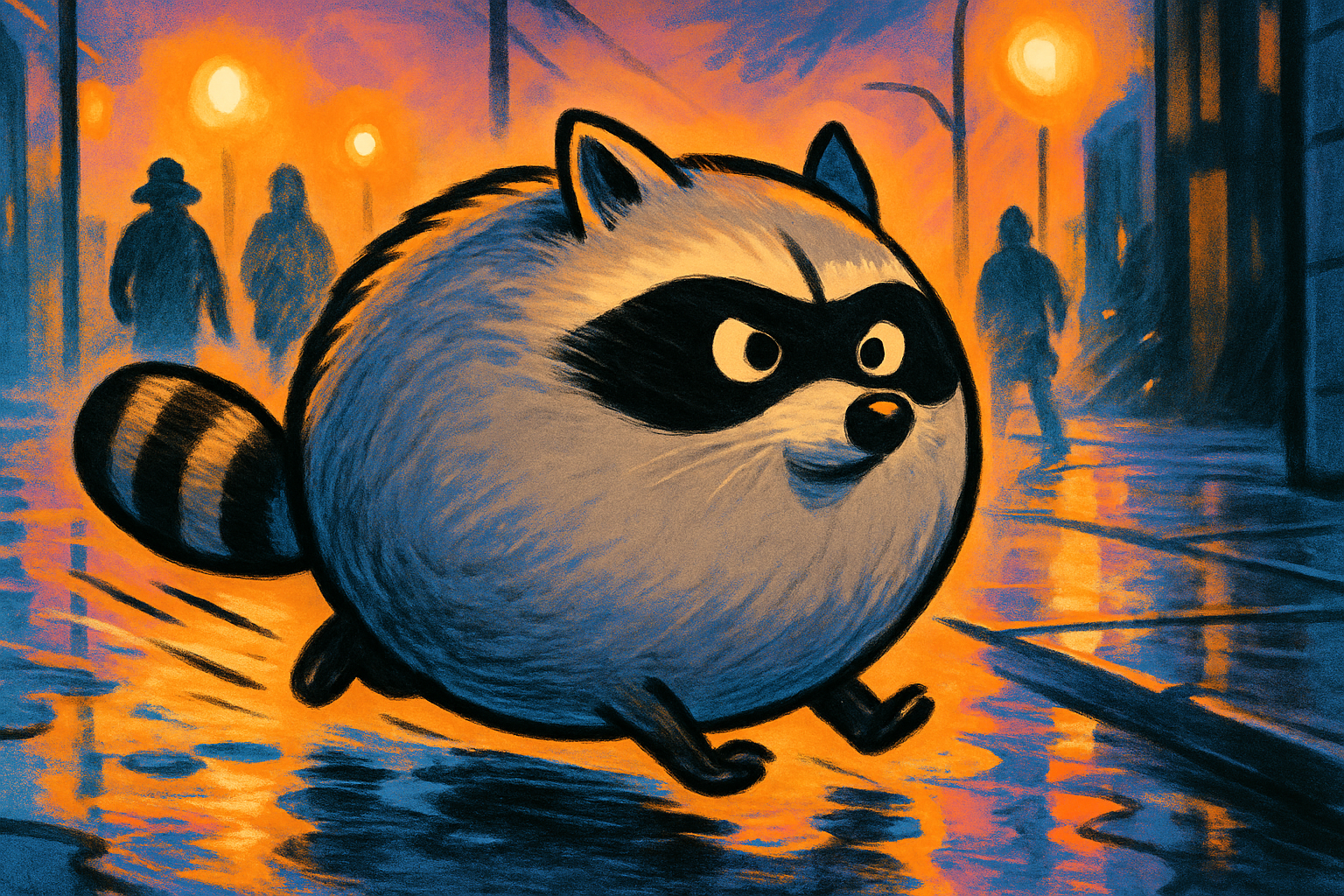
Every so often the internet picks a small animal, decides collectively that it loves this creature more than most people it has met, and refuses to let go. This month the honour belongs to a raccoon named Jimothy. He was filmed scampering across a Seattle pavement with an unusually short, round body and a scuttle somewhere between a Tasmanian devil and a wind-up toy, and within days he had a mural, a nickname, meme coins, a spot in two video games and a shout-out from the White House social team. This is the story of how that happened, what is actually known about him, and the surprising amount that is not.
What actually happened
Let's start with the confirmed core, because a lot of what is flying around online is embellishment.
A Seattle resident named Kiana Hall, a 33-year-old marketing specialist, was out for an evening walk with her husband on 13 July 2026 when she noticed something moving under a parked car. She assumed it was a cat. It was not. When the animal turned around she saw the familiar masked face and realised she was looking at a raccoon -- just one with a strangely compressed, rounded shape and a gait that did not match anything she recognised.
She recorded a short clip. On it you can hear her ask the question that half the internet has since repeated: "What am I looking at?" As for the name, she kept it simple -- he "just looks like a Jimothy," she said. She posted the video, and it detonated. As the BBC reported, Hall's reel passed more than eight million views by the following Friday morning; ABC News put the figure at "approximately 8 million." The clip was filmed in Seattle's Ballard neighbourhood -- Popular Science pins the first sighting to a spot near a Goodwill store there.
That is the solid centre of the story. Almost everything else is either context or affectionate speculation, and it is worth being honest about which is which.
The video that started it
Hall has been generous in describing the moment, and her account has stayed consistent across outlets, which is reassuring when a story travels this fast. "I initially thought I saw a cat under a car and wanted to have a closer look," she told Popular Science, "then realized it wasn't the shape of a cat at all."
Speaking to NBC's Kimmy Yam on Today, she added: "I was pretty surprised and confused, because the body shape didn't look like anything I was familiar with. He turned around and I saw that masked pattern on the front of his face, and that's when I realized he was a raccoon." And on her own sudden, secondhand fame -- to KING-TV's Alex McLoon: "I'm confused, but I'm pleased. I'm glad that he seems to be bringing people some joy."
That last line is a decent summary of the whole phenomenon. Nobody set out to build a viral animal. A person filmed something odd, said what she was thinking, and the feed did the rest.
What "short spine syndrome" actually is -- and what nobody can confirm
The caption on Hall's original video described him as "Jimothy the raccoon with short spine syndrome," and that label has stuck. Here is the part the memes tend to skip: no one has actually examined Jimothy. Every medical claim about him is a guess made from watching videos, and the vets who have spoken publicly are careful to say so.
Dr Brian Collins, a veterinarian at Cornell University, told Newsweek that short spine syndrome, or SSS, is his best guess but a presumptive one -- you cannot properly diagnose it without X-rays. The condition, he explained, is far better documented in dogs, where it "can lead to missing vertebrae, or deformed or fused vertebrae." The result is an abnormally shaped back and a reduced ability to turn the head and neck, which fits what everyone is seeing on screen. A Seattle vet, Carrie Schneider of the Family Pet Veterinary Hospital, told KIRO-TV the same thing in plainer terms: "It does look quite unusual, but it is a condition that happens in other mammals as well."
Just how unusual is striking. Dr Catherine Love, Arkansas's state wildlife veterinarian, told Newsweek that fewer than 30 cases of SSS have been documented worldwide -- in dogs. That makes it, in her word, "ultrarare" in a wild raccoon. She noted that Jimothy also appears to have an unbalanced gait and a corkscrew tail, both consistent with the picture.
So the honest version is this: Jimothy very probably has a rare congenital spinal condition, the experts broadly agree on what it looks like, and none of them can prove it from a phone video. That uncertainty is not a hole in the story. It is the story -- a wild animal became a global celebrity faster than anyone could get close enough to actually check on him.
How worried should we be about Jimothy?
This is where the affection online tips into genuine concern, and where the vets are worth listening to closely, because their message is more hopeful than the doom-scrolling suggests.
The good news first. Collins said SSS "probably won't shorten Jimothy's natural lifespan" -- dogs with the condition often live well into their teens. Dr Love was similarly encouraging: because Jimothy is at least three months old, the age at which raccoons typically leave the nest, and is already foraging and climbing on his own, he has "cleared the most significant developmental hurdles and has a strong chance of survival." She called him "a resilient little traveler."
The most quoted line came from Marcie Logsdon, a veterinarian at Washington State University, who told the Seattle Times that Jimothy looks "very spry" and that his spine does not appear to be holding him back. "The fact that he's made it to this age tells me that he's managing and that he's adapting," she said. "I was surprised and honestly a little bit inspired that he's that resilient."
The real risks are more prosaic than the condition itself. Collins said Jimothy's biggest challenges are predators -- "the biggest concern would be dogs" -- and cars. Because he cannot flex or turn easily, dodging either is harder for him than for an ordinary raccoon. There is also a subtler danger created by the fame itself. Julian Avery, a professor at Penn State, warned Newsweek about habituation: "It's common to entice with food, or to augment diet, but these things can lead to reduced welfare for Jimothy." In other words, the crowds who love him could hurt him if love turns into hand-feeding.
For context on the stakes: raccoons in the wild typically live only two to three years. Whatever happens next, Jimothy has already had a bigger year than most.
Why the internet fell for him -- and why brands did too
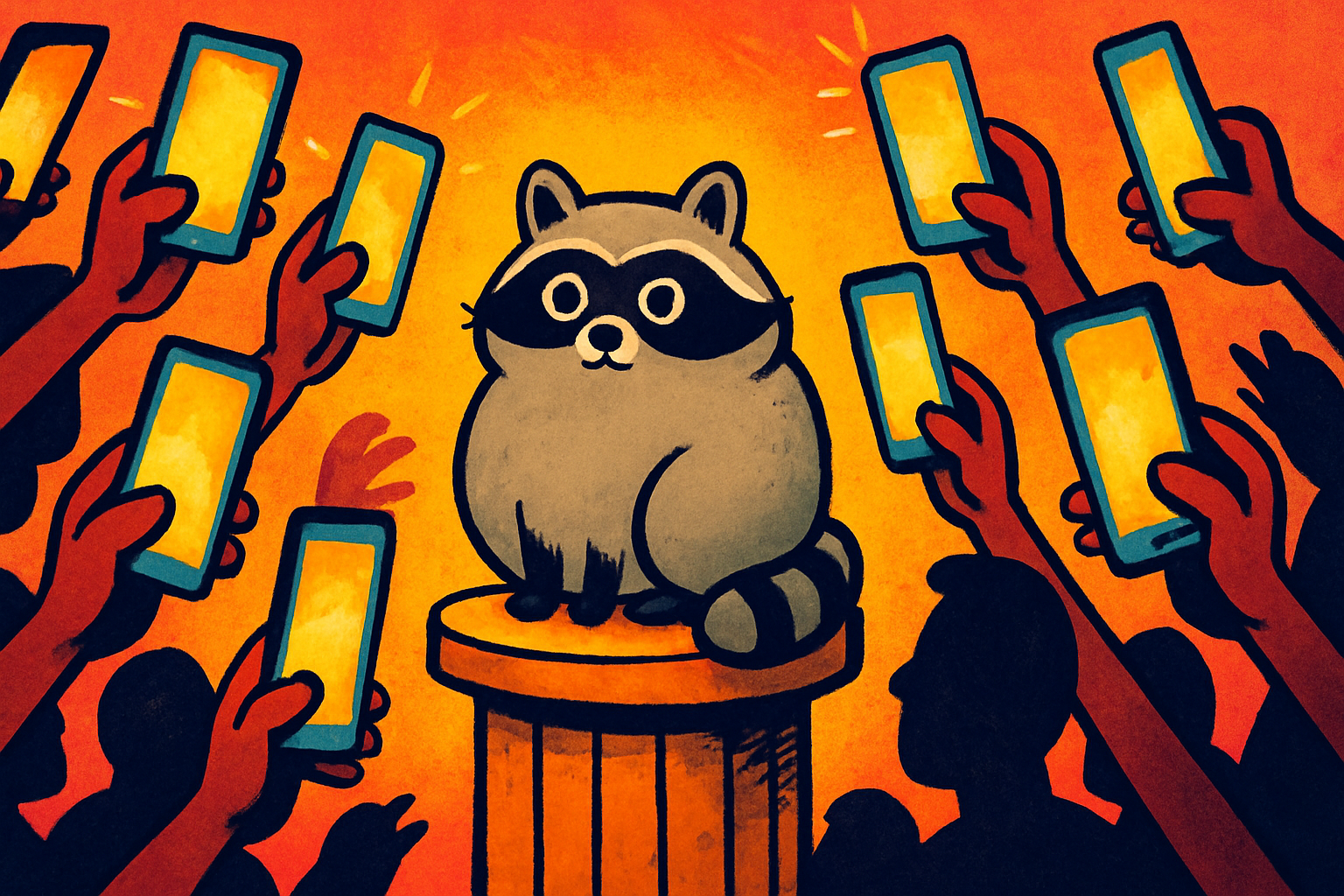
Jimothy did not appear in a vacuum. He follows a well-worn path blazed by the likes of Moo Deng, the pygmy hippo, and Neil the Seal before him, and belongs to the long, strange lineage of shareable animals that runs back through Grumpy Cat and Doge. A dog called Pig went viral in 2014 partly because he, too, had short spine syndrome. The template is old: take one animal that is at once cute, distinctive and slightly chaotic, and the internet will do the rest.
Dr Idil Galip, a digital-culture researcher, gave the BBC a tidy explanation for why these moments keep happening -- and happening faster. "As cities expand and food waste increases, humans and raccoons cross paths more often," she said. "More encounters mean more footage of raccoons being funny and in today's fast-moving, saturated feeds, that footage can become a meme almost instantly."
Then the commercial machinery arrives. On Galip's reading, "Meme marketing is now standard practice for many brands. They will hop on to whatever's trending, hoping the visibility rubs off on them." Jimothy proves the point almost comically well. Search his name on Google and, per the BBC, an animation of him scurries across your screen. Crypto opportunists spun up meme coins in his honour -- the usual digital tokens of questionable value that latch onto any viral moment. He is slated to turn up in World of Warcraft's fictional Azeroth, and Minecraft's official account claims him too. Even the White House's social media accounts, no strangers to online culture, shared a Jimothy meme: a post on X showing the raccoon in a red hat reading "Trump was right about everything." (The picture is the point there; read nothing more into it than that a big account grabbed a trending animal.)
From memes to murals: the real world catches up
What makes Jimothy a slightly different case is how quickly the affection spilled off the screen and into physical Seattle.
A local artist, Andrew Miller, painted a mural of him behind the Ballard Clay pottery studio. People have walked into the neighbourhood's Electric Kitten Tattoo asking for Jimothy tattoos; its owner, Laura Exley, told KING-TV she thinks she understands why. Jimothy is a "symbol of resilience," she said. "He's dealing with life a little bit differently, and he seems to be fine. And I think that resonates with a lot of us." The Seattle Mariners posted a photo of him in a team cap and even worked him into a mascot race during a game. He has picked up honorifics online -- "King Jimothy" -- and his own seasonal meme, "Hot Jimothy Summer." And then there is the merchandise: the National Bobblehead Hall of Fame and Museum unveiled an officially licensed, individually numbered Jimothy bobblehead, a small grey figure on a grass-textured base, priced at 30 dollars plus shipping and due out in December. "Jimothy, Seattle's newest hometown hero... has a growing fan base across the nation," the museum's co-founder and chief executive Phil Sklar said in announcing it.
There is even a civic postscript, though this is one to hold loosely. Councilmember Alexis Mercedes Rinck planned an official proclamation commemorating a "Jimothy Summer," reported to take place at noon on 26 July at Bergen Place Park near the Ballard Farmers Market, complete with an invitation to local artists to bring Jimothy-themed work for a friendly competition. "We invite all local artists to bring their Jimothy-themed art," she posted. "Long live, Jimothy!" As of writing -- the day after that scheduled date -- I could not independently confirm the event had actually taken place, so treat it as planned rather than done.
Backstory has been filling in from neighbours, too. A Ballard resident, Ben Trammell, posted footage of Jimothy as a baby, describing a raccoon family that had lived for years in a stand of cedar trees. Another local, Dmitriy Ishimsky, who shared clips of Jimothy padding along his fence, said he first saw the raccoon as a baby about a year ago and had wondered what became of him. "Seeing videos of him now -- and knowing he's becoming a little local celebrity -- makes me so happy," he wrote. "More than anything, I'm just glad he's okay."
Please don't try to pet the raccoon
For all the warmth, officials have had to issue the same weary reminder that follows every viral animal: admire from a distance. Washington's state health department put it about as bluntly as a government account can on Threads: "As long as you don't try to pet him, cuddle him or feed him, Jimothy poses zero public health risk." The state's Department of Fish and Wildlife struck the same note when a spokesperson told KIRO 7 it was unclear what caused his unusual shape and asked people to leave him alone, adding that he appears more than capable of moving and feeding himself. Which is to say -- he is a wild animal, he is doing fine on his own, and the kindest thing his new fans can do is give him room.
What we could not confirm
In the spirit of not adding to the pile of embellishment, here is what this piece deliberately does not claim. It does not present his short-spine label as a settled medical fact, because he has never been examined -- every expert calls it a guess from video. It does not give a precise, ever-growing view count, because the only figure any source stands behind is "more than eight million" on the original reel. It does not tell you how old he is or when he was born: accounts range from a baby filmed in 2025 to claimed sightings as far back as 2017, which some suggest might mean there has been more than one short-spined raccoon in the area. And it does not promise you the city proclamation happened.
None of that dims the appeal. If anything it sharpens it. A small, oddly shaped, entirely wild raccoon wandered across a Seattle sidewalk and, for one saturated summer, became a folk hero -- resilient, unbothered, and getting on with his night. Long may Jimothy scamper.
Sources
All figures, quotes and names above are drawn from reporting we opened and read:
- BBC News -- How Jimothy the raccoon became the internet's latest animal obsession
- Smithsonian Magazine -- An Unusual-Looking Raccoon Nicknamed Jimothy Is Winning Hearts Across the Internet (Sarah Kuta)
- Newsweek -- Animal expert weighs in on Jimothy, the short-spined raccoon in Seattle (Anna Skinner)
- Popular Science -- Jimothy the raccoon has a rare spinal condition. Here's what that means (Jennifer Byrne)
- ABC News -- 'Jimothy' the raccoon captures the internet's heart (Mason Leib)
- Yahoo Life -- Jimothy is a Seattle raccoon with a rare spinal condition. Here's how he became the internet's new It animal (Kaitlin Reilly)
- Yahoo News / KIRO 7 -- Proclamation planned for 'Jimothy,' Seattle's eccentric raccoon (Lexi Herda)
- Yahoo Entertainment / KIRO 7 -- Jimothy, Seattle's internet-famous raccoon, gets official bobblehead (Lexi Herda)