Sports · Cricket Analysis
How India's 2026 T20 World Cup Victory Revealed Cricket's Shifting Center of Gravity
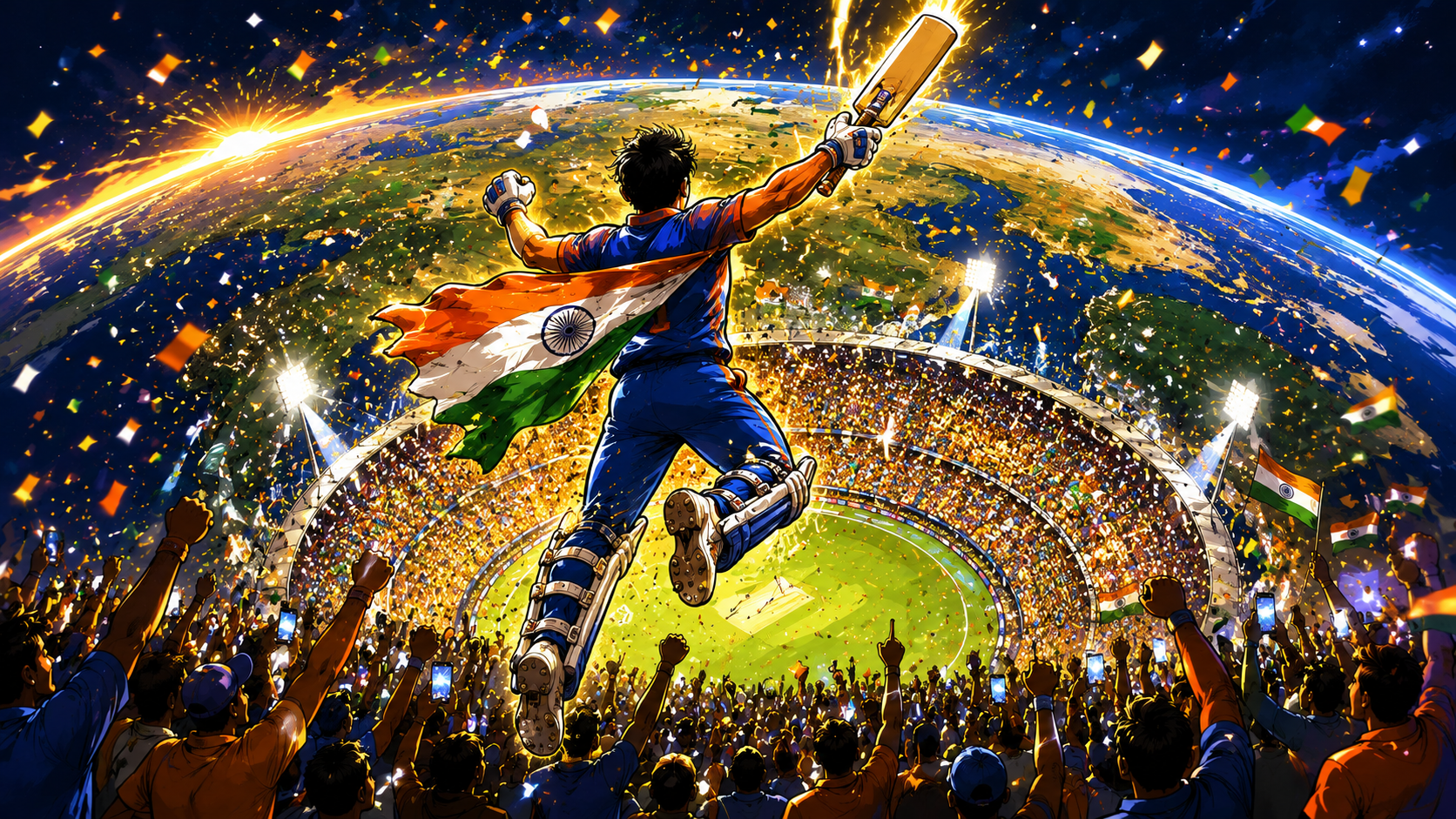
In March 2026, India defeated New Zealand by 96 runs in the T20 World Cup final at Narendra Modi Stadium. The victory marked three simultaneous records and revealed how a truly global sport remains geographically concentrated in its audience and revenue.
Hey everyone, it's Lapi~
In March 2026, India defeated New Zealand by 96 runs in the T20 World Cup final at Narendra Modi Stadium in Ahmedabad. That result, standing alone, would be a significant sporting achievement. But the win carried three simultaneous records: India became the first nation to successfully defend a T20 World Cup title, the first to capture the championship on home soil, and the first to claim three overall titles. More than four months have passed since that March afternoon. Looking back, the victory reveals something larger than cricket statistics. It shows where the sport's largest audience, its commercial center, and its institutional power have consolidated.
This is not a story about whether India played well. It is a story about what a home championship, combined with India's television dominance, tells us about how a truly global sport remains geographically uneven in its reach and profitability.
The Match and Its Historical Framing
On March 8, 2026, India's team posted 255 runs for the loss of 5 wickets in 20 overs. New Zealand managed 159 all out in 19 overs. The 96-run margin was decisive, but the numbers themselves matter less than what they represented within the tournament's context.
Sanju Samson scored 89 runs from 46 balls, an innings that broke the record for the highest individual score in a T20 World Cup final. His contribution was one of three half-centuries India's batting lineup produced that day—Ishan Kishan 54 off 31 balls, Abhishek Sharma 52 off 23 balls—building a total that had never been reached in a World Cup final of this format before. The opening partnership between Samson and another batter accumulated 92 runs in the powerplay, which itself stands as the joint-highest powerplay score in T20 World Cup history.
With the ball, India's Jasprit Bumrah claimed four wickets for 15 runs. He became the first bowler ever to achieve a four-wicket haul in a T20 World Cup final. Axar Patel took three more, unraveling New Zealand's chase before it gained momentum.
These individual statistics sit inside a larger frame: India had now won the T20 World Cup in 2007 (the format's inaugural year), 2024 (in the United States, defeating South Africa by 7 runs), and 2026 (at home, defeating New Zealand by 96 runs). West Indies and England each held two titles. India's third crown placed it alone at the top of the all-time championship list. The back-to-back victories in 2024 and 2026 made India the first team ever to defend the title. And no other host nation had ever won a T20 World Cup championship on home soil.
Three records at once. Each one would be historical. Together, they marked a shift.
Tournament Structure: A Modern Format
The 2026 T20 World Cup ran from February 7 to March 8, 2026. Warm-up matches occurred February 2–6. Twenty nations participated. The group stage (February 7–20) divided the teams into four groups of five, with each team playing the others in its group once. The top two teams from each group advanced to the Super Eight phase.
The Super Eight stage (February 21 – March 1) used a preset seeding system that split the eight qualified teams into two groups of four. Australia, India, West Indies, and South Africa formed one Super Eight group; New Zealand, Sri Lanka, England, and Pakistan formed the other. Each team played the other three members of its group once. The top two from each Super Eight group advanced to the semi-finals.
The semi-finals occurred March 4–5. The winners faced each other in the final on March 8.
The tournament was co-hosted by India and Sri Lanka. Eight stadiums hosted matches: five in India (Narendra Modi Stadium in Ahmedabad, M. A. Chidambaram Stadium in Chennai, Arun Jaitley Stadium in Delhi, Eden Gardens in Kolkata, and Wankhede Stadium in Mumbai) and three in Sri Lanka (R. Premadasa Stadium and Sinhalese Sports Club Cricket Ground in Colombo, and Pallekele Cricket Stadium in Kandy). Narendra Modi Stadium, with a capacity of 132,000, is the world's largest cricket stadium and is more than double the capacity of any other venue used for World Cup hosting.
The Question of Home-Field Advantage in Global Sports
Winning a world championship at home carries different weight than winning away. The home team faces lower travel fatigue and an audience tilting heavily in its favor. But there is also an institutional advantage: a home victory reorganizes how a sport's commercial center is perceived.
India winning the T20 World Cup at home marks a recognition that when a sport's largest audience is geographically concentrated, a home victory in that geography becomes the event's economic and cultural center. The 2024 T20 World Cup took place in the United States, where cricket remained a niche sport. The India-South Africa final drew viewers, but not with the density that India can produce.
The 2026 tournament, held across India and Sri Lanka, with the final in Ahmedabad, changed that calculation. India's victory in India before an Indian audience, broadcast primarily to India, created an event of an entirely different commercial scale. That is not a triumph of athletic excellence alone. It is a triumph of geography, media infrastructure, and the concentration of a global sport's viewership in one region.
What the Viewership Data Revealed
The India vs. England semi-final on March 5, 2026, set a streaming record: 65.2 million peak concurrent viewers on JioHotstar. The final surpassed even that. The ICC confirmed 72.5 million peak concurrent digital viewers globally for the India-New Zealand match. This represents the highest concurrent viewership recorded for any live digital event in history.
That concentration of audience tells a story. Cricket's largest gathering points are in India and South Asia. When a tournament is held in that geography and features India as a participant—especially as a finalist—the audience consolidates at scales that dwarf other sporting events. The 2026 T20 World Cup final, drawing 72.5 million concurrent digital users globally, indicates that cricket's primary audience, measured by participation peaks, now lives in Asia.
What the Concentration Means for Cricket's Future
The 2026 tournament demonstrated a defining paradox: cricket is simultaneously expanding globally and consolidating around one geographic market. The T20 format, by its brevity and broadcast-friendly structure, has opened the sport to new audiences beyond its traditional strongholds. Franchise cricket leagues in the US, Europe, and other regions have introduced the sport to audiences that would not have engaged with longer formats.
But the 2026 World Cup's viewership peak—72.5 million concurrent digital viewers globally—occurred not in a neutral venue but in India, and it centered on India as the championship contender. That concentration is not incidental. It reflects how modern sports economics work: the largest audience generates the largest revenue, which drives investment, broadcast priority, and institutional focus. The sport's global reach and its geographic concentration are not contradictory facts. They are simultaneous. Cricket is becoming a truly global sport. It is also becoming a sport where one geographic market—India—represents the overwhelming plurality of the audience, and therefore the commercial center of gravity.
Individual Excellence Within the Team Achievement
Sanju Samson's 89 in the final was his third successive score of 80 or more runs in a T20 World Cup tournament. This record had been achieved only once before in the tournament's history. Across the entire tournament, Samson accumulated 321 runs at a strike rate of 199.37. These are not merely high numbers; they represent a performance threshold that few batters achieve in any format of cricket.
Jasprit Bumrah's four-wicket haul in the final was not merely a strong bowling performance. It was a historic boundary-crossing. No bowler had previously taken four wickets in a T20 World Cup final. Bumrah's 4 for 15 was both a match-winning contribution and a statistical milestone that had never existed before that day.
But these individual achievements matter primarily because they occurred within India's collective triumph. A great batting or bowling performance in a losing cause becomes a footnote. These performances, combined with contributions from India's other players and the team's collective execution, produced the victory that reorganized the tournament's meaning.
The Records at a Glance
India's 2026 championship sits inside a frame of quantifiable achievements and historical moments. The table below documents the final, the path to it, and the broader T20 World Cup record.
| Achievement | Result | Venue | Date | Source |
|---|---|---|---|---|
| T20 World Cup 2007 (inaugural) | India champion | South Africa | March 2007 | ESPNcricinfo Tournament Records |
| T20 World Cup 2024 | India defeats South Africa by 7 runs | USA | June 2024 | ESPN Cricinfo Tournament Report |
| T20 World Cup 2026 final | India defeats New Zealand by 96 runs | Narendra Modi Stadium, Ahmedabad | March 8, 2026 | ESPNcricinfo Final Scorecard |
| Highest T20 World Cup final total | India 255/5 (2026 final) | Ahmedabad | March 8, 2026 | ESPNcricinfo Match Report |
| Highest individual final score | Sanju Samson 89 (46 balls) | Ahmedabad | March 8, 2026 | ESPNcricinfo Final Scorecard |
| First back-to-back T20 World Cup champion | India (2024, 2026) | USA & India | June 2024 – March 2026 | ESPNcricinfo Tournament Records |
| First home-nation T20 World Cup champion | India (2026) | Ahmedabad | March 8, 2026 | ESPNcricinfo Tournament Hub |
| Most T20 World Cup titles (all-time record) | India, 3 titles | Multiple venues | 2007, 2024, 2026 | ESPNcricinfo Tournament Records |
| Sanju Samson tournament average | 321 runs at 199.37 strike rate | Tournament-wide | Feb 7 – Mar 8, 2026 | ESPNcricinfo Tournament Statistics |
| Jasprit Bumrah final performance | 4 for 15 (first 4-wicket haul in T20 final) | Ahmedabad | March 8, 2026 | ESPNcricinfo Match Report |
| Peak concurrent digital viewers (final) | 72.5 million | Global | March 8, 2026 | ESPNcricinfo Streaming Data |
| Peak concurrent viewers (semi-final) | 65.2 million (India-England) | Digital platforms | March 5, 2026 | ICC Streaming Record Announcement |
Understanding What Changed and What Remained
India's 2026 T20 World Cup victory marked a moment when several trends intersected. Cricket's largest audience is in Asia, particularly India. The most profitable matches are those involving India. The sport's technological infrastructure (particularly streaming) has matured in India to the point where it can handle unprecedented concurrent viewership. Home-field advantage in a modern world championship, when that home is in the sport's primary market, creates an amplification effect.
What did not change: Cricket remains a sport with significant audiences in Australia, England, New Zealand, Pakistan, Sri Lanka, the West Indies, and other traditional strongholds. It remains a sport where Australia or England can produce spectacular performances and compete for championships. The geographic concentration we saw in 2026 does not erase the global nature of the competition.
What did change: The idea that a truly global sport must have evenly distributed viewership was challenged. The 2026 T20 World Cup showed that a sport can be genuinely international in participation while having a viewership that is geographically concentrated. And when that concentration occurs in a high-income market with mature broadcast infrastructure (India's digital platforms and television networks), the commercial and cultural scale of the sport's biggest moments becomes unprecedented.
A Lasting Question
The 2026 T20 World Cup final revealed something about sports' future that extends far beyond cricket. As audiences fragment across platforms and geographies, the moments when a sport concentrates its entire global audience in one match become rarer and more valuable. But those moments seem to require a particular condition: they require that one team or nation represents the plurality of the sport's audience, and they require that the championship be held in that geography.
India achieved both. That is why March 8, 2026, stands as a record-breaking day not just for cricket, but for sports broadcasting and audience concentration itself.
Sources
- ICC — Men's T20 World Cup 2026 — Tournament Hub
- ESPNcricinfo — T20 World Cup 2026 Tournament Hub
- ESPNcricinfo — T20 World Cup 2026 Final Scorecard (India vs. New Zealand)
- ESPNcricinfo — T20 World Cup 2026 Tournament Statistics and Averages
- ESPNcricinfo — T20 World Cup 2026 Schedule, Fixtures and Results
- ICC Media Release — Semi-Final Streaming Record: 65.2M Concurrent Viewers
- ESPNcricinfo — Final Full Scorecard (India vs. New Zealand)
- ESPNcricinfo — T20 World Cup 2026 Points Table and Group Standings
This source list is evidence for the structure and official facts above, not an endorsement of any team, sport, or streaming platform.