Electronic Arts Is Set to Go Private on August 4 in a $55 Billion Deal
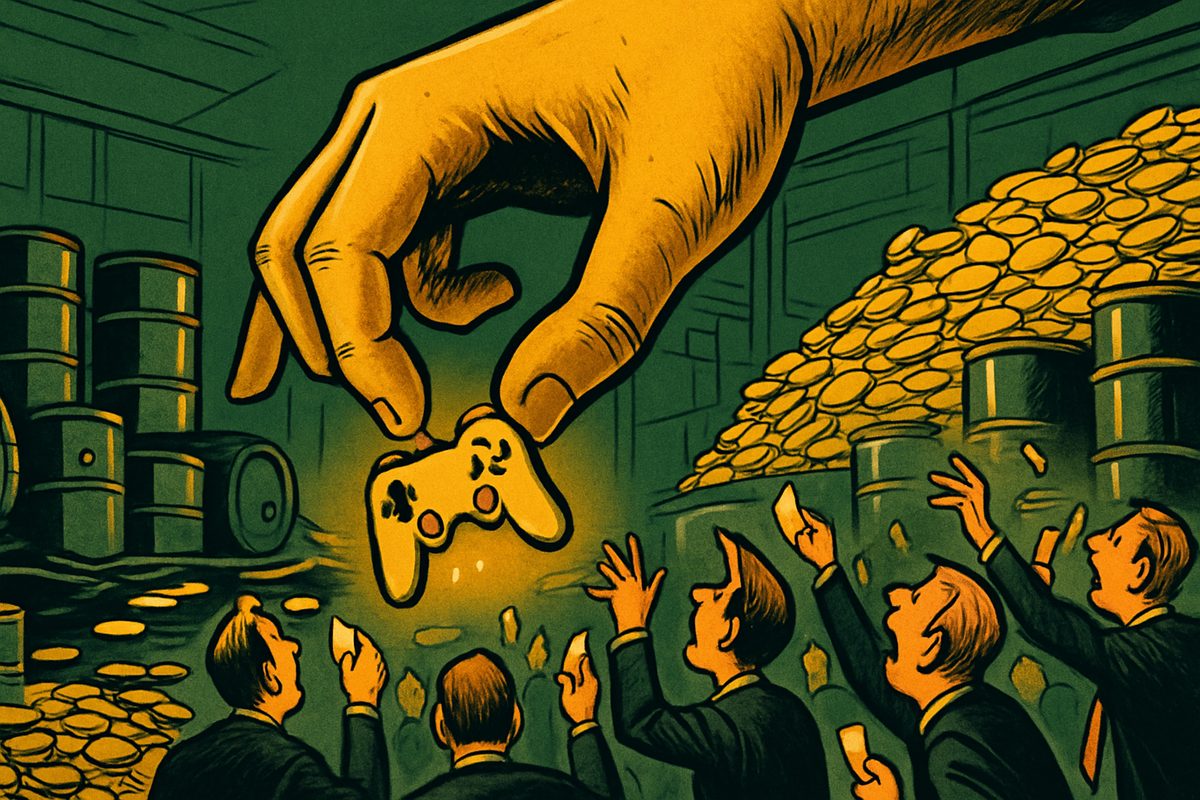
What It Means That Saudi Arabia's Wealth Fund, Silver Lake and Jared Kushner Are Buying the Maker of EA Sports FC
Here is the fast answer. Electronic Arts — the company behind EA Sports FC, Madden, The Sims and Battlefield — told the U.S. Securities and Exchange Commission in a July 30 filing that it expects to complete its sale on or about the close of trading on August 4, 2026. When it does, EA will stop being a public company. Its shares will be bought for $210 each in cash, the whole thing values EA at about $55 billion, and the buyers are a group led by Saudi Arabia's sovereign wealth fund. After the money changes hands, you will no longer be able to buy a share of EA on the stock market at all.
That is a lot to have happen quietly on a Tuesday, so this piece separates what is now locked in from what is still a guess. Where a fact comes from a document EA filed with regulators, it is marked confirmed. Where it is a characterisation or a forecast, it is marked as such. A take-private this large generates a great many confident sentences from people who do not have to file anything; the filings are the part that has to be true.
The trust key
- Confirmed: stated in an EA filing with the SEC, or in EA's own announcement, which we opened and read.
- Reported: carried by recognised outlets, with the limits noted.
- Unconfirmed: a possibility that no official document settles.
Confirmed at a glance
| Question | Status | What you can safely conclude |
|---|---|---|
| When does it close? | Confirmed (expected) | On or about the close of trading, August 4, 2026 — subject to the last customary conditions. |
| How much per share? | Confirmed | $210 in cash. |
| What is EA worth in the deal? | Confirmed | About $55 billion, all-cash. |
| Who is buying? | Confirmed | A consortium of PIF, Silver Lake and Affinity Partners. |
| Do the regulators still need to sign off? | Confirmed — done | EA says all required regulatory approvals were obtained as of July 30, 2026. |
| Did shareholders agree? | Confirmed | Yes, at a special meeting on December 22, 2025. |
| Will EA stay on the stock market? | Confirmed — no | Its common stock will no longer be listed on any public market after the close. |
| Will there be layoffs or game changes? | Unconfirmed | No filing says; anything specific here is a guess. |
What actually changed on July 30
Confirmed. For most of the past ten months this deal has been a waiting game — announced, voted through, then stuck in the slow queue of competition regulators around the world. Trade coverage flagged the timing first — Variety reported EA was set to close "next week" — but the SEC filing is the primary record, and it is the moment that queue emptied. In its own words, the 8-K states: "As of July 30, 2026, all regulatory approvals required to complete the Merger have been obtained. Electronic Arts currently expects the Merger to close on or about the close of trading on August 4, 2026."
Read the tense carefully, because it matters. The deal has not closed yet. "Currently expects" and "on or about" are the language of a company that is confident but not finished — the filing adds that completion "remains subject to the satisfaction or waiver of the remaining customary closing conditions." Those are the routine last boxes, not new hurdles. But until the money moves, the honest description is expected to close August 4, not closed. If you see a headline this week saying EA "has gone private," it is running slightly ahead of the paperwork.
The terms, in plain numbers
Confirmed. EA announced the agreement on September 29, 2025, in a statement it also filed with the SEC as an exhibit. Shareholders are being paid $210 per share in cash — a 25% premium over EA's unaffected closing price of $168.32 on September 25, 2025, the last trading day before news of the talks leaked. It is even a premium over EA's unaffected all-time high of $179.01, reached that August. In an all-cash take-private, "premium" is the whole pitch to shareholders: sell now at a fixed, guaranteed price rather than ride the share price yourself.
How the buyers are paying for it is the part worth slowing down on. The roughly $55 billion breaks into about $36 billion of equity — real money the consortium is putting in, including Saudi Arabia's Public Investment Fund rolling over the 9.9% of EA it already owned — and $20 billion of debt, committed entirely by JPMorgan Chase Bank, of which $18 billion is expected to fund at closing. EA describes the transaction as "the largest all-cash sponsor take-private investment in history." That superlative is EA's own claim in its announcement filing, not an independent ranking, so treat it as the company's framing — but it gives you the right sense of scale. This is not a normal buyout.
Who is actually buying EA
Confirmed. Three names are on the deal, and they are not interchangeable.
- PIF, the Public Investment Fund, is Saudi Arabia's sovereign wealth fund and the anchor here — it already held nearly a tenth of EA before any of this. Its executive on the deal, Turqi Alnowaiser, framed the logic in gaming terms: "PIF is uniquely positioned in the global gaming and esports sectors, building and supporting ecosystems that connect fans, developers, and IP creators."
- Silver Lake is a technology-focused private-equity firm. Its co-CEO Egon Durban called EA "a special company: a global leader in interactive entertainment, anchored by its premier sports franchise."
- Affinity Partners is the investment firm run by Jared Kushner, who said he "grew up playing their games — and now enjoys them with his kids." Affinity has previously raised much of its capital from Gulf sovereign funds, which is part of why this particular trio drew the attention it did.
The through-line is that a very large amount of the money reshaping video games right now is sovereign, and Saudi in particular. PIF's own statement puts esports alongside gaming as a sector it is deliberately building in. That ambition is not abstract: it is the same push that turned the Esports World Cup into a mainstream broadcast property, a tournament with a $75 million prize pool that spent its first two years based in Saudi Arabia before rotating out to Paris. Owning the studio behind EA Sports FC is the publishing end of the same strategy that funds the tournaments. To be precise about what is and is not established: PIF's interest in gaming and esports is on the record in this deal; any claim that PIF runs or bankrolls that specific tournament is not something these filings prove, and this piece does not make it.
The vote, and the long regulatory road
Confirmed. Shareholders had their say early. At a special meeting on December 22, 2025, holders of EA stock voted to adopt the merger agreement, laid out in the definitive proxy statement EA filed that November. Of the 250,106,129 shares entitled to vote, the merger proposal passed with 201,459,396 for, 1,915,837 against and 90,331 abstaining — a lopsided yes, which is what you would expect when the offer is a fat cash premium.
The slower part was the regulators. A deal this size, crossing this many borders and involving a foreign sovereign fund, has to clear competition and national-security reviews in multiple jurisdictions. EA's filings mark the milestones along the way — the U.S. antitrust waiting period under the Hart-Scott-Rodino Act, for instance, lapsed back in February 2026. The July 30 filing is the finish line for all of it: every required approval, EA says, is now obtained. That is the single fact that turned this from "agreed" into "about to happen."
What we are not telling you, on purpose
To keep this clean, here is what no document we opened confirms, so it stays out:
- Layoffs, studio closures or headcount changes. None are stated. Big buyouts are often followed by cost-cutting, and it is fair to watch for it — but "often" is not "announced," and there is no number to report.
- Any change to the games themselves. Whether new owners will touch pricing, content or a franchise's direction is exactly the kind of thing people assume and no filing says. Assume nothing.
- The precise sequence of each regulator's approval. Trade outlets have reported dates for individual clearances, such as the European Union's. The primary filing we relied on states only that all approvals were in hand by July 30, so that is what we state.
Each of those is a real question. None has a verified answer today, and printing a guess as a fact is the failure this desk exists to avoid.
Why a stock leaving the market is worth your attention
Confirmed. The blunt consequence is in EA's own words: after the deal, "EA's common stock will no longer be listed on any public market." Going private is not just an ownership change; it is EA stepping out of the public gaze. A listed company files quarterly numbers, discloses executive pay, and answers to thousands of shareholders. A private one, owned by a wealth fund and two investment firms, does far less of that in public. For a company whose products sit on hundreds of millions of screens, that reduction in what has to be disclosed is itself a story — arguably the most consequential thing about the whole deal, and the part least visible in a $210 share price.
EA's leadership frames it as freedom to move faster. Chairman and CEO Andrew Wilson, who stays on to run the company from its Redwood City headquarters, said the sale is "a powerful recognition" of his teams' work and that EA will "continue to push the boundaries of entertainment, sports, and technology." Lead independent director Luis A. Ubiñas put the board's case more narrowly: the deal "delivers compelling value for stockholders." Both things can be true at once — a good price for the people selling, and a quieter company for everyone who plays the games.
The bottom line
The deal: Electronic Arts expects to go private on or about August 4, 2026, bought for $210 a share in an all-cash transaction that values it at about $55 billion. The buyers: a consortium of Saudi Arabia's Public Investment Fund, Silver Lake and Jared Kushner's Affinity Partners, paying roughly $36 billion in equity and $20 billion in JPMorgan-committed debt. The status: shareholders approved it in December 2025, EA says every regulator has now signed off, and only the routine closing conditions remain. What is still unknown: everything about what the new owners do next — jobs, prices, the games — because none of it is in a filing yet. Watch August 4 for the close, and watch the months after for the answers the paperwork does not contain.