Abi Martin's Last Routine of the Night Held England's Bronze Together at Glasgow 2026
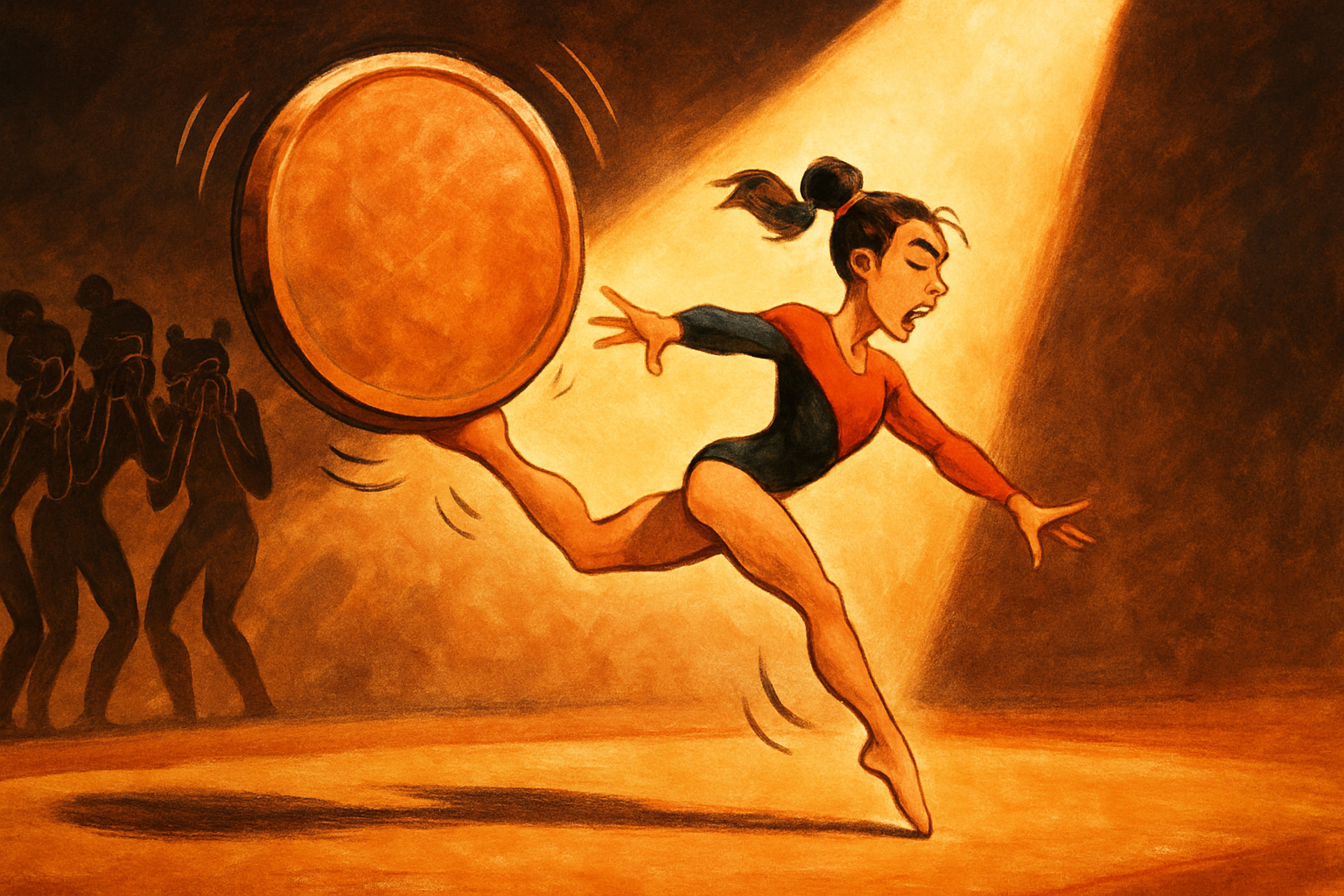
There is a particular kind of pressure in gymnastics that no other moment in sport quite reproduces. It is the final routine of a team final, when your score is the last one that will be posted, when the standings are so tight that a tenth of a point decides whether you go home with a medal or with fourth place, and when the only thing left between your team and the podium is you, a spring floor, and ninety seconds of choreography you have done a thousand times but never once with this much riding on it.
That was the situation Abi Martin walked into on Saturday, 25 July 2026, at the Emirates Arena in Glasgow. England needed her floor routine. She scored 13.250, and it was enough. England took bronze in the women's artistic gymnastics team final; Wales, tantalisingly close all evening, finished just off the podium in fourth. This is the story of how that medal was actually won, and of the wider night it belonged to.
The result, laid out plainly
The women's team final at Glasgow 2026 finished like this: Australia took gold with 158.400, Canada silver with 157.300, and England bronze with 154.300. Wales came fourth, close enough that the outcome was not settled until the very last rotations were on the board.
England's team was Abi Martin, Ruby Stacey, Shannah-Kae Grant, Alia Leat and Shantae-Eve Amankwaah. Canada's silver-winning line-up was led by the vastly experienced Ellie Black, alongside Gabrielle Black, Lia-Monica Fontaine, Lia Redick and Alyssa Guerrier-Calixte. Australia's champions were Georgia Godwin, Kate McDonald, Ruby Pass, Breanna Scott and Emily Whitehead.
I want to be careful here about one number I am deliberately not giving you. Several places have reported the exact margin by which England edged Wales, and it is tempting to state it, because a precise figure always reads as more authoritative. But the sources I could actually open and read did not put that margin on the record — they said only that the scores were, in the words of the agency report, "tantalisingly close." So I will tell you England finished ahead of Wales narrowly, and I will not invent the decimal. That gap between "narrowly" and a fabricated tenth of a point is exactly the sort of thing that gets a small site into trouble, and it is not worth it.
Why the last routine mattered so much
Team finals in artistic gymnastics are cumulative. Each nation's total is built rotation by rotation across the four apparatus — vault, uneven bars, balance beam and floor — and the running order means that some athletes perform while the standings are still loose and others perform when everything has tightened to the point of agony. Martin drew the second kind of moment.
Her own account of it, given to Team England afterwards, is refreshingly free of false modesty about the score and honest about what actually carried her through. "It may not have been my highest score ever, but it was definitely the best performance," she said. That distinction matters more than it sounds. A gymnast can score higher on a cleaner day with lower difficulty and a forgiving panel; what she was describing was a routine that delivered exactly when the delivery was the whole point. "I knew that I had to go out there and give it my best for the whole team," she added, "and luckily I really did that tonight."
She also credited the room. Glasgow's arena was loud, and she leaned into it rather than trying to shut it out. "I could hear the crowd screaming and that, along with my song, gave me all the adrenaline," she said. Anyone who has watched a floor routine knows the trick of it — the good ones ride the noise instead of fighting it, and the music and the crowd become a kind of metronome you perform on top of.
Her teammate Ruby Stacey caught the honest chaos of the moment from the other side of the arithmetic. "I don't really know if we knew what score Abi had to get exactly," Stacey admitted, before adding the only summary that really mattered: "we're all really happy." That is a very human detail. The idea that a team stands there coolly calculating the exact number they need is mostly a television fiction; in reality you often just watch, hope, and find out when everyone else does.
Martin herself is 18, from Devon, and a world bronze medallist — a genuinely serious gymnast rather than a lucky understudy, which is worth saying because "teenager holds nerve" narratives can accidentally make it sound like the result was a fluke. It was not. It was a good gymnast doing her job at the exact moment the job was hardest.
The one thing this medal was not
There is a framing I want to push back on before it forms, because it is the kind of thing that sounds right and is quietly wrong. This was not England's home Games. Glasgow 2026 is Scotland's home Games — Great Britain's, if you want to be broad about it — and the roar Martin was riding was a British crowd, not specifically an English one. England competing in Glasgow are visitors in the same building as everyone else, even if the accents in the stands are familiar. It is a small point, but getting it wrong would misrepresent the whole texture of the night, so I am flagging it rather than letting the easy version stand.
Defending champions, quietly overtaken
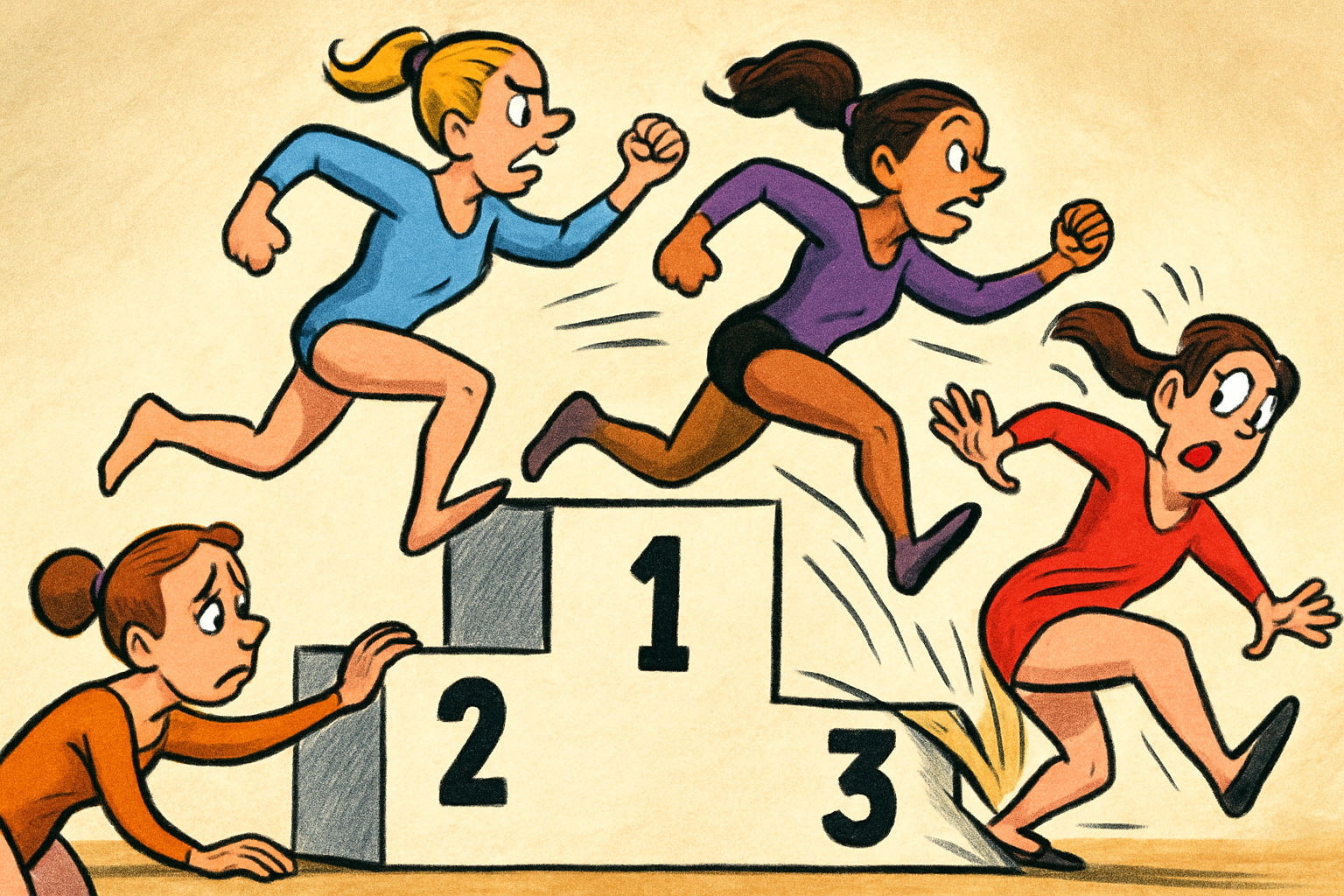
Here is the context that gives the bronze its real shape. England did not arrive in Glasgow as underdogs scrapping for a place on the podium. They arrived as the defending champions.
At Birmingham 2022, England's women won the team title outright with 161.100, ahead of Australia's silver on 158.000 and Canada's bronze on 152.700. That was a different squad and a home Games in the literal sense, and it was a statement result. Four years on, in Glasgow, the same three nations filled the podium again — but the order had rearranged itself completely. Australia, silver in 2022, climbed to the top. Canada, bronze in 2022, moved up to silver. And England, gold in 2022, came down to bronze.
That is not a collapse. Three nations traded places on the same podium, which tells you the competitive gap between them is small and moves around from cycle to cycle. But it does mean that England's bronze was won against the weight of their own recent history — they were the team with the target on their back, not the team chasing one, and holding onto a medal at all under that expectation is its own kind of achievement.
There is a neat thread of continuity running through it, too. Georgia Godwin, Breanna Scott and Emily Whitehead were all part of the Australian team that took silver behind England in 2022, and all three were back in the line-up that took gold in 2026. The same athletes, one step higher, four years later. Sport rewards that sort of persistence more often than it rewards sudden brilliance, and Australia's rise from silver to gold with a familiar core is a tidy example of it.
The rest of the gymnastics programme
The team final was one night inside a longer gymnastics programme at these Games, and the individual all-around final the following day, Sunday 26 July, is worth setting alongside it because it reinforces the same picture: Canada and Australia at the very top, with the host nation producing a breakthrough of its own.
In the women's all-around, Ellie Black of Canada won gold with 53.050, ahead of Australia's Breanna Scott on 52.900 and Canada's Lia-Monica Fontaine on 52.800. Black's win carried a piece of history with it — she became the first gymnast, man or woman, to win a second Commonwealth Games all-around title. For a sport that churns through generations quickly, staying at the top across enough years to win the same crown twice is genuinely rare.
The men's all-around gave Scotland its moment. Reuben Ward won gold on home soil with 79.650, ahead of Canada's Felix Dolci on 79.450 and Australia's Jesse Moore on 79.000, and in doing so became the first Scottish gymnast, of either sex, to win the Commonwealth all-around title. If you are going to end a decades-long wait for a home champion, doing it in front of the Glasgow crowd is about as good a script as you could ask for.
Why a result like this is worth writing down
It would be easy to file a team bronze as a minor footnote — not the gold, not the headline, not the record. But I think the smaller medals are often where the more interesting sport lives. A gold won by a dominant team tells you who was best. A bronze decided by one teenager's floor routine, with a fourth-placed team a fraction of a point behind, tells you something about pressure, running order, and the specific cruelty of a scoring system where the last performer of the night carries the whole result on her shoulders.
What I can stand behind, cleanly: on 25 July 2026 at the Emirates Arena in Glasgow, England won the women's artistic gymnastics team bronze with 154.300, behind Australia's gold and Canada's silver, and Abi Martin's 13.250 on floor in the closing stages was the routine that held it together against a fourth-placed Wales. The exact size of that final margin, and Martin's precise home town beyond "Devon," are details I could not pin to a source I opened, so I have left them as what they honestly are — close, and Devon — rather than dressing them up.
That is the whole story, and the honest edges are part of it. A defending champion slips to bronze, a teenager holds a podium place together with the last routine of the night, and two rivals climb over the top of them on a podium the three nations have now shared two Games running. Small medal, good story.
Sources
- Team England (official) — "Abi Martin propels Team England to women's team bronze": https://teamengland.org/news/abi-martin-propels-team-england-to-womens-team-bronze
- Gymnastics Canada (official) — "Canada Captures Women's Artistic Gymnastics Silver at Commonwealth Games": https://gymcan.org/canada-captures-womens-artistic-gymnastics-silver-at-commonwealth-games/
- Gymnastics Now — "2026 Commonwealth Games gymnastics results: Every final from Glasgow": https://gymnastics-now.com/commonwealth-games-2026-gymnastics-results/
- Gymnastics Now — "Ellie Black, Reuben Ward triumph in all-around finals at 2026 Commonwealth Games": https://gymnastics-now.com/2026-commonwealth-games-gymnastics-all-around-finals-live-results/
- Enfield Independent — "Martin delivers dazzling display in team final": https://www.enfieldindependent.co.uk/news/26410500.martin-delivers-dazzling-display-team-final/
- Wikipedia — "Gymnastics at the 2026 Commonwealth Games": https://en.wikipedia.org/wiki/Gymnastics_at_the_2026_Commonwealth_Games
- Wikipedia — "2026 Commonwealth Games": https://en.wikipedia.org/wiki/2026_Commonwealth_Games
- Wikipedia — "Gymnastics at the 2022 Commonwealth Games – Women's artistic team all-around": https://en.wikipedia.org/wiki/Gymnastics_at_the_2022_Commonwealth_Games_%E2%80%93_Women%27s_artistic_team_all-around
- The Guardian — "Abi Martin snatches bronze for England to deny Wales in artistic gymnastics": https://www.theguardian.com/sport/2026/jul/25/gymnastics-commonwealth-games-sri-lanka